Overview
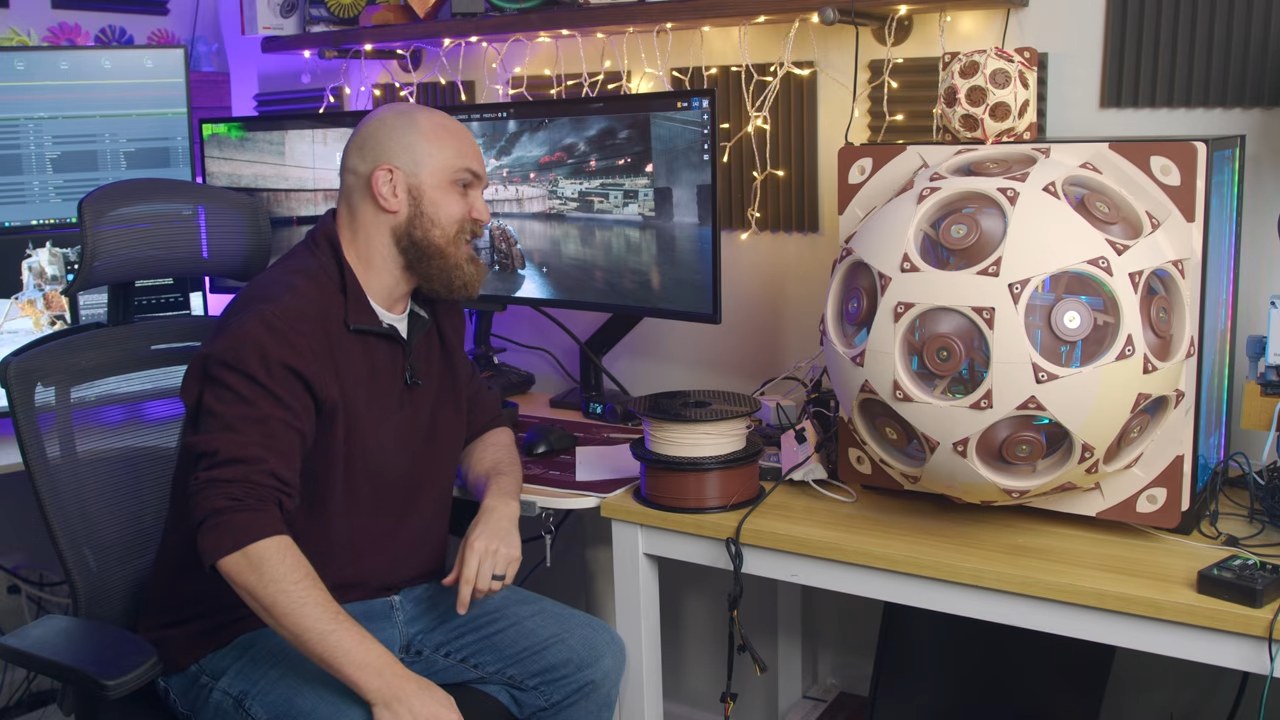
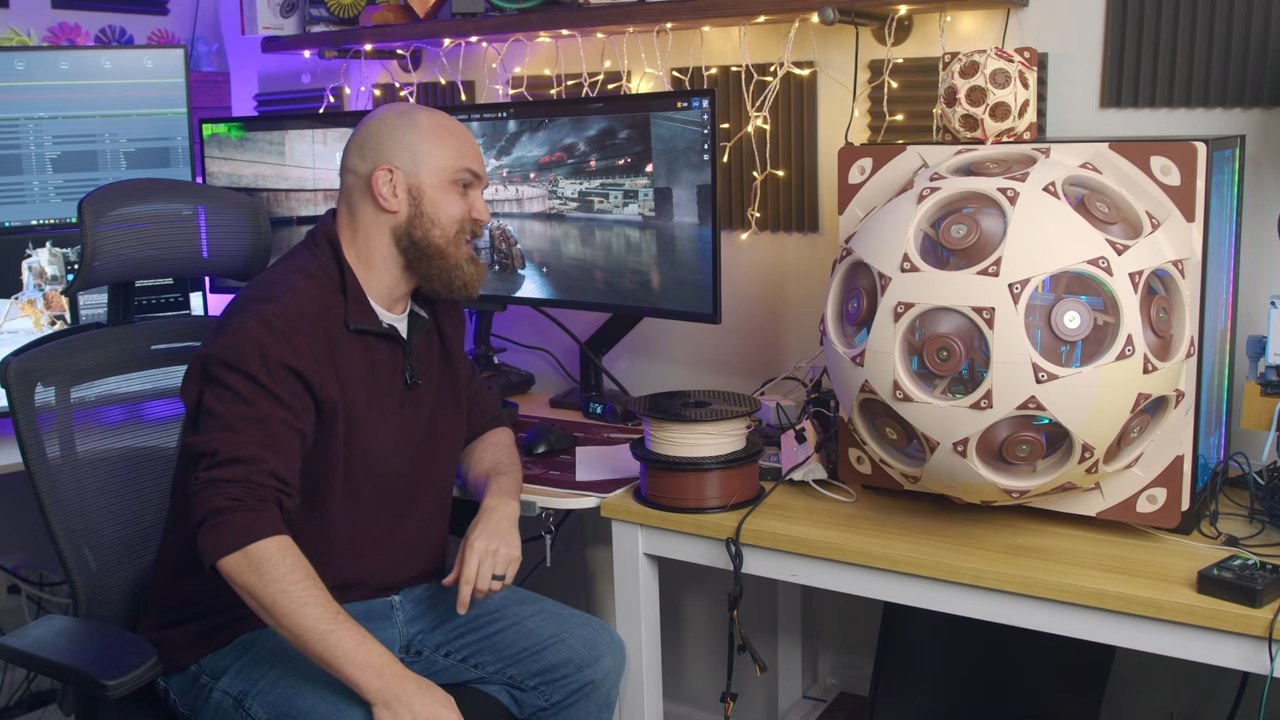
A custom PC build recently debuted a cooling solution that borders on industrial scale, featuring a side panel constructed entirely from 15 Noctua fans. The creator, who dubbed the assembly the 'Superdome,' demonstrated that the sheer volume of airflow generated by the array could drop internal component temperatures by a measurable 20 degrees Celsius. This radical approach to thermal management challenges conventional wisdom regarding optimal airflow design in high-performance desktop systems.
The build, showcased by the YouTuber, moves far beyond standard radiator mounts or even elaborate liquid cooling loops. By dedicating an entire vertical surface to high-static-pressure fans, the system achieves an unprecedented level of forced convection. The resulting temperature delta is significant enough to warrant serious discussion among hardware enthusiasts and system builders alike, forcing a re-evaluation of how extreme cooling is approached in modern computing.
This extreme cooling setup highlights a persistent tension in the PC hardware space: the desire for peak performance versus the practical constraints of thermal dissipation. While liquid cooling and optimized case airflow have long been the industry standard for high-end rigs, the 'Superdome' proves that sometimes, sheer brute force airflow remains the most effective, if visually excessive, solution.
The Mechanics of Extreme Airflow Management
The Mechanics of Extreme Airflow Management
The core engineering feat of the Superdome lies in its sheer scale and the strategic deployment of components. The side panel is not merely a collection of fans; it is a meticulously arranged, high-density airflow conduit. Using 15 individual Noctua fans—a brand known for its efficiency and low noise profile—the builder created a continuous, high-volume exhaust or intake path.
The technical data presented suggests that the cooling effect is directly proportional to the volume of air moved and the efficiency of the fan array. Achieving a 20°C drop is not trivial; it indicates that the system was operating under significant thermal load, and the cooling solution successfully managed to pull heat away from critical components like the CPU or GPU far faster than typical passive or semi-active cooling methods.
This methodology forces a consideration of fan selection. Noctua fans, while often associated with premium pricing, are frequently cited for their exceptional static pressure capabilities. In a massive, dense array like the Superdome, static pressure—the ability to push air through resistance (like dust filters or tight grilles)—is arguably more critical than pure CFM (Cubic Feet per Minute) output, ensuring that the entire 15-fan surface operates with consistent, powerful force.
Rethinking Case Design and Thermal Limits
The existence of the Superdome forces a conversation about the limitations of standard PC case architecture. Most manufacturers design cases with a balance of aesthetics and function, often leading to airflow bottlenecks or restricted component placement. The Superdome, by contrast, treats the entire case perimeter as a cooling opportunity, essentially turning the side panel into a massive, dedicated heat exchanger.
From a design standpoint, the build is a statement. It prioritizes thermal performance above all else, accepting the resulting visual commitment. This trend reflects a segment of the enthusiast market that views cooling not just as a necessity, but as a primary performance feature. When temperature is the limiting factor in performance (as seen with thermal throttling), an aggressive, oversized cooling solution becomes a justifiable, if dramatic, engineering choice.
The implication for case manufacturers is clear: if high-end users are willing to build custom, over-engineered cooling solutions like this, the industry needs to provide more modular, high-airflow options that allow for such extreme customization without compromising structural integrity or aesthetic appeal. Current market offerings often treat airflow as a secondary concern to visual design.
The DIY Culture and Performance Extremism
This project is a prime example of the intersection between high-end DIY culture and performance extremism. The builder did not simply buy a pre-built cooling system; they engineered a bespoke solution from commodity, high-quality components. This DIY approach is a hallmark of the most dedicated segments of the tech community, where the challenge of optimization often outweighs the cost or complexity of the solution.
The Superdome is less a piece of standard hardware and more a performance art piece. It proves that the performance gains achievable through meticulous, over-the-top engineering can sometimes eclipse the perceived efficiency of integrated, factory-designed cooling solutions.
However, this extreme approach also raises questions about practicality and efficiency. While the 20°C drop is impressive, the power draw, noise profile (even with high-quality fans), and sheer physical footprint of the Superdome must be factored into a holistic system assessment. For the average user, the marginal performance gain from such an elaborate system rarely justifies the complexity or cost.