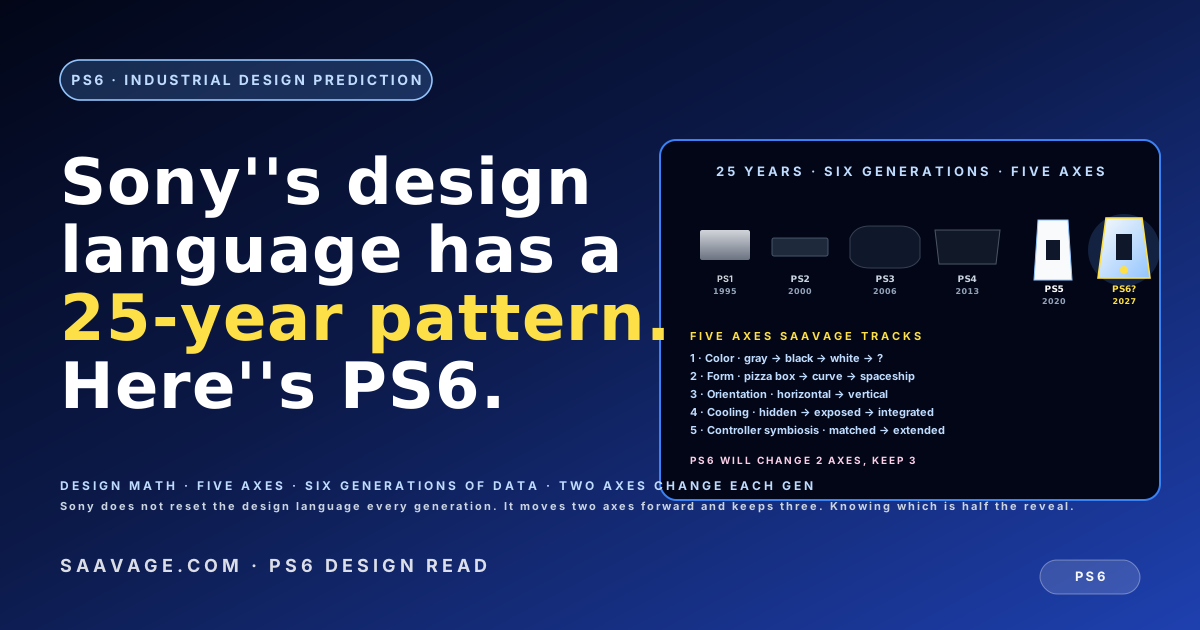
The five axes, and why they are the right unit of analysis
Industrial design is often treated as a single property, a console is described as 'angular' or 'curvy' or 'white' or 'black', which collapses a multi-dimensional decision space into a single adjective. That is the analytical mistake that makes console-reveal articles so useless for prediction. Sony's actual design process works on multiple independent axes. The chassis silhouette is one decision. The color palette is another. The cooling integration is a third. The orientation preference is a fourth. The controller relationship is a fifth. Each axis evolves on its own schedule, with its own internal logic, and each generation is the result of moving some axes forward while holding others stable. Decompose the design into axes, trace each axis across generations, and the pattern emerges.
The five axes me uses: color (the surface palette of the console chassis), form-factor (the silhouette signature, pizza box vs curve vs parallelogram vs spaceship), orientation (horizontal vs vertical default), cooling integration (how the thermal venting reads visually, hidden slots vs edge vents vs integrated sculpting), and controller symbiosis (whether the controller matches the console or contrasts with it). These five capture essentially all the design choices that define how a PlayStation generation looks on a living-room shelf. Other smaller axes exist, port layout, logo placement, material finish, but those are subordinate to the five and evolve within the constraints the five set.
The key observation is that across six generations, pS1 (1995), pS2 (2000), pS3 (2006), pS4 (2013), pS5 (2020), and the PS5 Pro refresh (2024), sony has moved approximately two axes per generation while keeping three stable. PS1 to PS2 kept form-factor (still box-shaped), kept orientation (horizontal), kept controller symbiosis (matched pad), and moved color (gray to black) and cooling (hidden slot evolution). PS5 to PS5 Pro moved form-factor (more angular cuts) and cooling (refined side-wing geometry) and kept color, orientation, controller. The pattern is legible. If you know which two axes will move for PS6, you know most of what the reveal will show.
Sony's PlayStation design trajectory spans 25 years and six generations, and follows a consistent two-axes-change-three-keep pattern
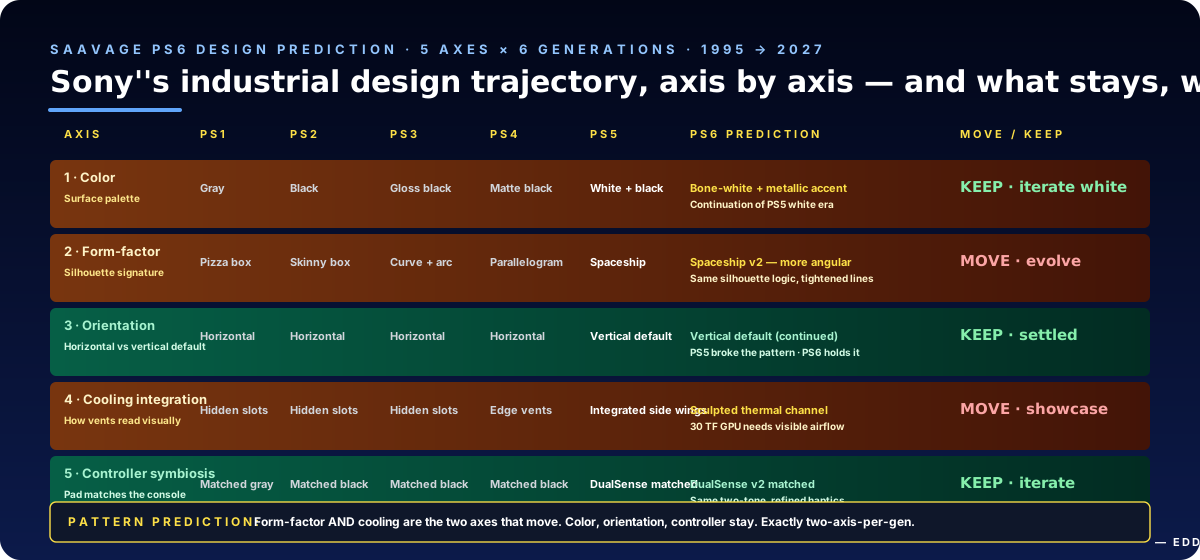
Tracing each axis, and which two will move for PS6
Color has moved twice across six generations: PS1 gray to PS2 black (2000), then PS4 matte black to PS5 white-and-black (2020). Between those two moves, color stayed remarkably stable across 13 years. The PS5 white-and-black was a legitimately bold choice, playStation had been synonymous with black for two decades, and the shift was treated by the design press as a brand reset. That reset was meant to last. Sony has shown zero indication of wanting to go back to black in the PS5 Pro, and the PlayStation branding materials through 2025 and 2026 have leaned hard into white-and-metallic aesthetics. The prediction: PS6 continues the white era, probably with a bone-white primary surface and a metallic silver or titanium accent ring rather than the black inserts of PS5. This is a KEEP axis, with mild iteration.
Form-factor has moved every generation since PS3. PS3's curved arc was a response to the PS2's skinny-box era. PS4's parallelogram was a response to the PS3's heat-management complaints. PS5's spaceship was the biggest single-generation move in PlayStation history. PS6 will continue the spaceship silhouette, it would be design whiplash to abandon it after a single generation, but the lines will tighten. The PS5 had somewhat organic curves; the PS6 will push toward more angular, engineered surfaces. This is a MOVE axis, and the move direction is spaceship-evolution rather than spaceship-replacement. Orientation moved once, from horizontal-default (PS1 through PS4) to vertical-default (PS5). The PS5 vertical-default was controversial in 2020 but has become natural, and the PS5 Pro kept it. Vertical-default is settled now. KEEP axis.
Cooling integration is the axis that is about to move the most. PS1 through PS3 had cooling vents that were visually hidden, the console was expected to look like consumer electronics, and vents were utilitarian side details. PS4 edged toward edge vents that were part of the silhouette. PS5 integrated the cooling wings into the primary spaceship silhouette, the white side panels that make the PS5 unmistakable are, structurally, the cooling system. PS6's 30 TF GPU will produce substantially more heat than PS5, which means the cooling system has to scale up. The industrial-design question is whether Sony hides that scale or showcases it. Based on the pattern of cooling-integration becoming more visually primary every generation, the prediction is showcase: PS6 will have a sculpted thermal channel that runs through the chassis as a primary design feature, probably in metallic or contrast color. This is a MOVE axis, and it is the one I would bet on most strongly. Controller symbiosis has been stable since PS1, the DualShock family has always matched the console, and the DualSense will iterate rather than replace. KEEP axis.
The April 2027 reveal and what I will be watching
If the two-axes-move prediction holds, the April 2027 Road-to-PS6 reveal event will surprise approximately 20 percent of design observers and confirm the expectations of the other 80 percent. The form-factor evolution to more angular spaceship and the cooling showcase via sculpted thermal channel are the two things to watch for specifically. Everything else, the white-plus-metallic color palette, the vertical-default orientation, the matched DualSense v2, is high-confidence continuation.
The specific things I will be watching at the reveal: whether the thermal channel is a single continuous sculpt or a pair of parallel channels (single is more design-forward, pair is more functional). Whether the console's short-axis cross-section is triangular (a major move) or trapezoidal (an iteration of PS5). Whether the controller shell uses the same two-tone material split as DualSense or moves to a three-tone split that indicates new haptic zones. And whether the handheld SKU, which five of seven leak sources confirm, uses the same design language as the main console, or introduces a separate design vocabulary. My bet on the handheld: same design language, scaled down. Sony will not create two design systems simultaneously.
The bigger structural point is that predictable design-language evolution is actually a good sign for a console platform. It means Sony knows what a PlayStation is supposed to look like and is iterating on it rather than re-inventing it every generation. Nintendo's Switch-to-Switch-2 transition followed a similar logic, small iterations on a proven visual identity, and that decision aged well. PlayStation is now in the same mature-design-language era, which means the surprise at reveals is going to be incremental rather than shock-value. That is not a loss. Most design-language resets have been disasters (see the Xbox One at launch, which tried to be a media-center box and looked like a VCR). Sticking to the playbook is underrated. And the playbook, decomposed into five axes, is legible 19 months ahead of the reveal. Watch form-factor and cooling in April 2027. That is where the news will be.