Why backward-planning is more honest than forward-speculating
The forward-speculating mode of PS6 coverage is the default because it matches how leakers behave. Leakers find a fragment of information and extrapolate forward, this claim implies that outcome, which implies the next thing, and so on. The chain is brittle because any wrong fragment at the start propagates through everything downstream. Backward-planning does the opposite. Pick the known endpoint (Holiday 2027 launch, which is the leak-cycle consensus and aligns with Sony's historical seven-year cycle rhythm) and ask: what events must be true between now and then for that endpoint to happen on time? That approach is more stable because every milestone in the backward chain is independently verifiable, if a milestone slips, you know the next one is at risk without needing to revise the whole forward prediction.
The PS3, pS4, and PS5 launches all followed the same milestone structure. Dev kits to first-party studios roughly 24 months before launch. Silicon tape-out 18 months out. First-party dev kit sign-off (the event where Sony's internal studios confirm the hardware can run their planned launch titles) roughly 15 months out. Silicon yield validation 8 months out. Formal reveal event 7 to 9 months out. Price and date announcement 4 to 5 months out. Pre-orders 3 to 4 months out. Manufacturing ramp 2 to 3 months out. Review embargo lift 2 weeks out. Retail launch. The gaps between these milestones have been extraordinarily consistent across three generations, the variance from cycle to cycle is on the order of weeks, not quarters.
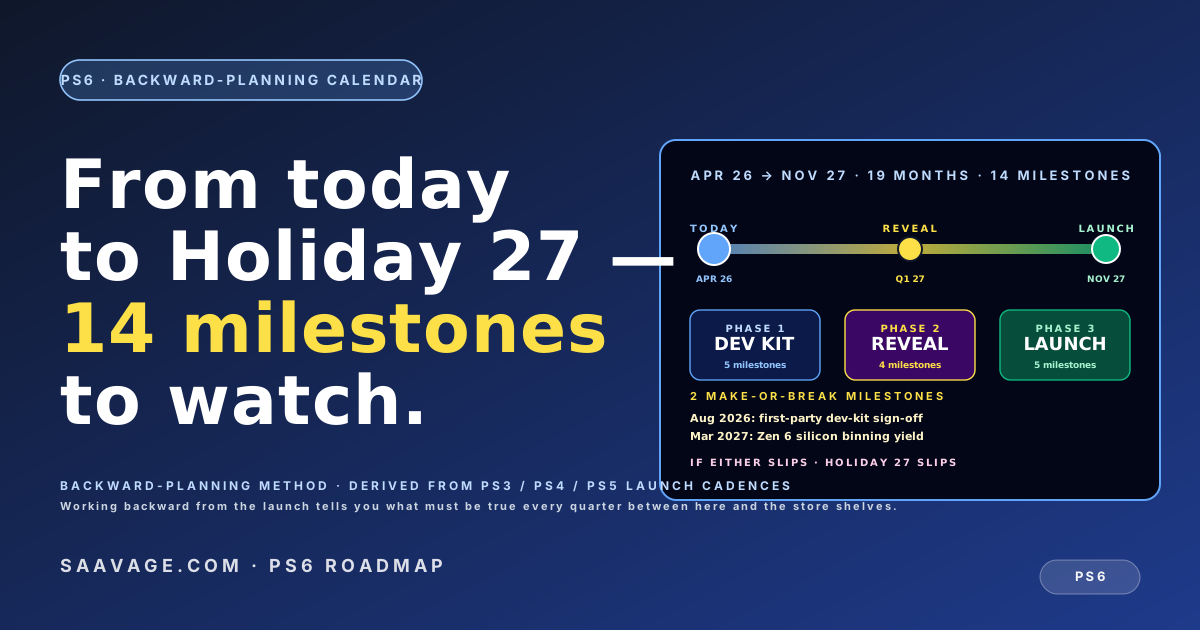
If you map those gaps onto the Holiday 2027 endpoint, which I read as November 15, 2027, give or take a week, you get a specific 14-milestone calendar that runs from April 2026 (now) through November 2027. Each milestone has a specific target month, a slip-risk classification, and a reason-it-matters annotation. Two of those 14 milestones are what I am calling make-or-break, which means if they slip the entire Holiday 2027 window is at risk. The other 12 are schedule events, they need to happen, but a slip of one of them can be absorbed within the overall cycle without affecting launch date. Distinguishing which is which is the main work of this article.
Working backward from a Holiday 2027 launch produces 14 distinct milestones between now and the PS6 launch
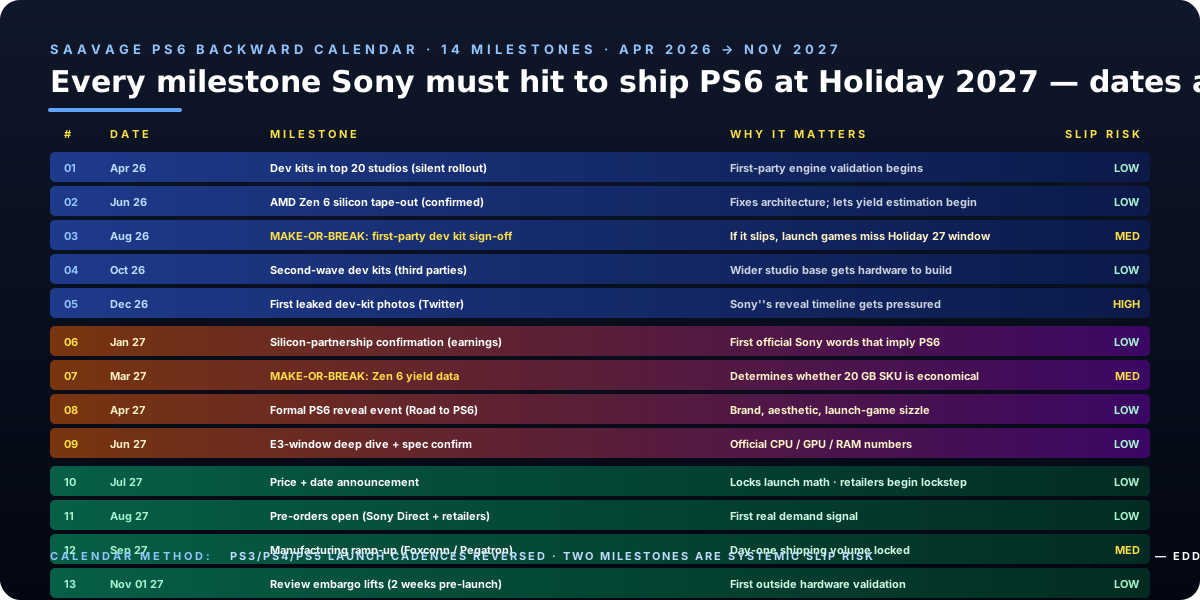
The 14 milestones, phase by phase
Phase 1 is the dev-kit phase and covers milestones 1 through 5. April 2026 (now): silent dev-kit rollout to roughly 20 first-party and closely-aligned third-party studios. This is happening now, confirmed by Kepler_L2 and corroborated by silicon-package photos in December 2025. June 2026: AMD Zen 6 silicon tape-out, the point at which the CPU architecture is frozen and AMD can begin yield estimation. August 2026: first-party dev kit sign-off, the first make-or-break milestone. This is when Insomniac, naughty Dog, santa Monica, and the other first-party studios confirm that the dev-kit can run their planned 2027 launch titles at target performance. If it slips, the launch-game lineup is at risk, which makes the Holiday 27 launch window untenable. October 2026: second-wave dev kits to wider third-party base. December 2026: first leaked dev-kit photos surface on Twitter, this milestone is not something Sony controls, but it historically happens in every console cycle and it forces Sony's hand on timing.
Phase 2 is the reveal phase and covers milestones 6 through 9. January 2027: silicon-partnership confirmation during the FY earnings call. Sony will use this to formally acknowledge AMD + Zen 6 without naming the product. March 2027: Zen 6 yield data from the foundry, the second make-or-break milestone. If silicon yield comes in below the 65 percent threshold that Sony needs to sustain the rumored $599 launch price, the whole price-performance equation breaks. Low yield means either higher launch price, lower-performance silicon, or a slipped launch while yield improves. April 2027: formal PS6 reveal event, what Sony historically calls the 'Road to' format. Brand, industrial design, launch-title sizzle. June 2027: E3-window or Summer Games Fest deep dive with official CPU, gPU, rAM spec confirmation. This is when the leak cycle is validated or invalidated.
Phase 3 is the launch phase and covers milestones 10 through 14. July 2027: price and date announcement. Retailers begin lockstep logistics. August 2027: pre-orders open. The first real demand signal, pre-order supply shortages or surpluses will indicate launch sizing. September 2027: manufacturing ramp at Foxconn and Pegatron. Day-one shipping volume is locked at this point. November 1, 2027: review embargo lifts, two weeks before launch. First outside hardware validation. November 15, 2027: launch day. Retail sell-through begins. The Holiday 27 window has either been achieved or it has been slipped to March 2028, depending on whether the two make-or-break milestones hit their targets.
The two milestones that actually decide the launch
The two make-or-break milestones, august 2026 first-party dev kit sign-off and March 2027 Zen 6 silicon yield, are the pressure points that determine whether Holiday 2027 holds. Everything else in the 14-milestone calendar can absorb a slip. If the December 2026 dev-kit photo leak happens in November instead, it does not matter. If the April 2027 reveal event slips to May 2027, it does not matter. These are schedule events, and schedules can flex within a quarter without changing the launch date. But the two make-or-break milestones are dependency-critical: they gate downstream work that cannot start until they hit.
The August 2026 dev kit sign-off is the one I will be watching most closely. It is the earliest indicator of whether Sony's launch-game lineup is viable, and because it happens internally inside first-party studios, it leaks through side channels (game-industry contract timelines, internal studio hiring patterns, engine-team move announcements) months before any official statement. Watch for Insomniac's Spider-Man 3 internal demos, naughty Dog's unnamed project milestone signals, and Santa Monica's God of War sequel engine validations. If those studios go quiet in the July-September 2026 window, it probably means they are heads-down on the dev-kit sign-off and the August 2026 target is on track. If those studios start publishing blog posts, hiring for ramp, and doing GDC talks in that same window, it probably means the sign-off has slipped and they are buying time. The second make-or-break milestone, march 2027 silicon yield, is harder to read externally because foundry data is not public, but the downstream signal (a price-and-date event slipping from July 2027 to later in Q3) will be visible if yield is tight.
The net: the PS6 backward calendar runs 14 milestones deep, the launch is plausibly on track, and the two dates that actually decide it are 4 months from now and 11 months from now. Everything between and after is downstream of those two. I will update this calendar quarterly as milestones hit or slip, and will flag any milestone deviation of more than six weeks as a potential launch-window risk. Forward-speculating the launch is entertaining. Backward-planning the launch is useful. Use the calendar, it is the single cleanest view of what Sony has to do and when.