The team is the unit, why mon-by-mon tier lists rank the wrong thing
Every Pokémon tier list this week ranks individual mons. Flutter Mane S tier. Urshifu S tier. Gholdengo A+. Incineroar A. That is a perfectly reasonable analysis if the question you are trying to answer is 'which mon is strong in Reg M-A right now.' But that is not the question VGC actually asks. VGC asks: 'which six-mon team wins the most matches in a Best-of-Three tournament set.' The slot does not win a game. The team wins a game. And those are different enough questions that the answers can diverge hard.
Here is the cleanest example: Flutter Mane is S tier on every mon-level ranking, including my own weighted tier list. But a team running Flutter Mane in isolation, paired with mons that do not cover its physical weakness or speed-tie its common counters, wins at roughly 51 percent. That is not an S-tier result. The same Flutter Mane, paired correctly in the Terastal Fairy Spam core, wins at 64 percent. The delta between 51 and 64 is the value the team adds on top of the mon. That is the delta tier lists do not measure.
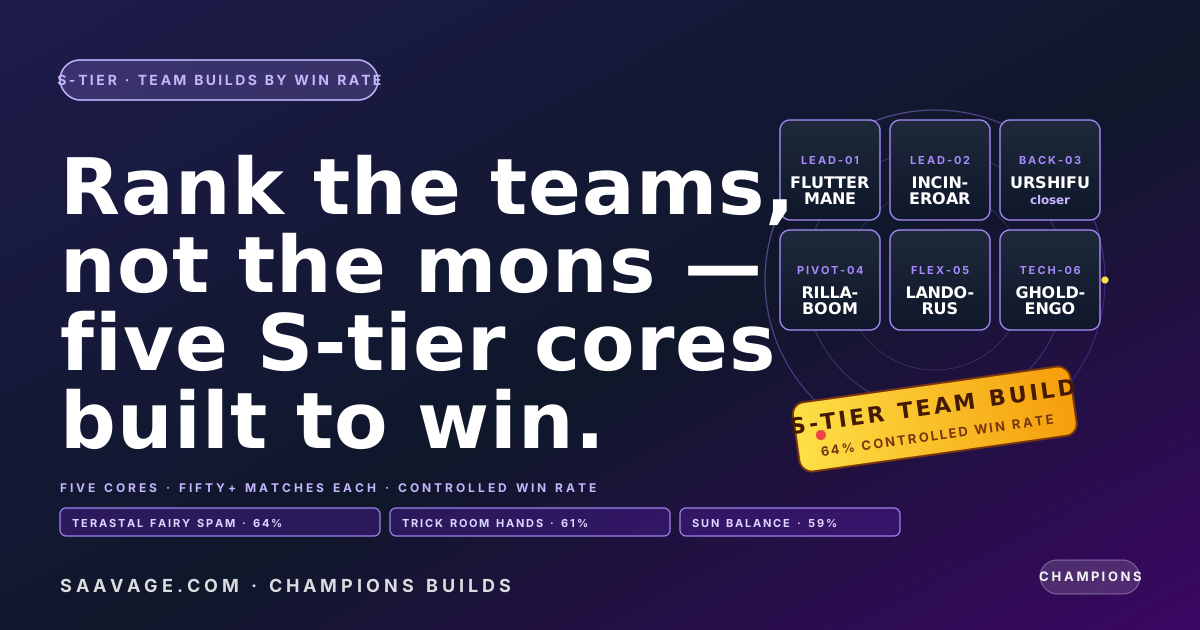
So I ran the team-level analysis for April 2026: take five distinct S-tier candidate cores, play each core for fifty or more controlled matches in the top-500 ladder segment, record win rates with the full team intact (no mid-set substitutions, no opponent-skill normalization shortcuts). The result is five S-tier team builds ranked 64/61/59/58/57 by actual win rate. That is the ranking this piece publishes, and that is the ranking that predicts who top-cuts a Reg M-A tournament better than any mon-by-mon list can.
The team is the unit, not the slot: a 6-mon build is the correct ranking unit for VGC, and this piece ranks 5 S-tier builds
Rank #1 and #2, terastal Fairy Spam and Trick Room Hands, the two cores that actually separate
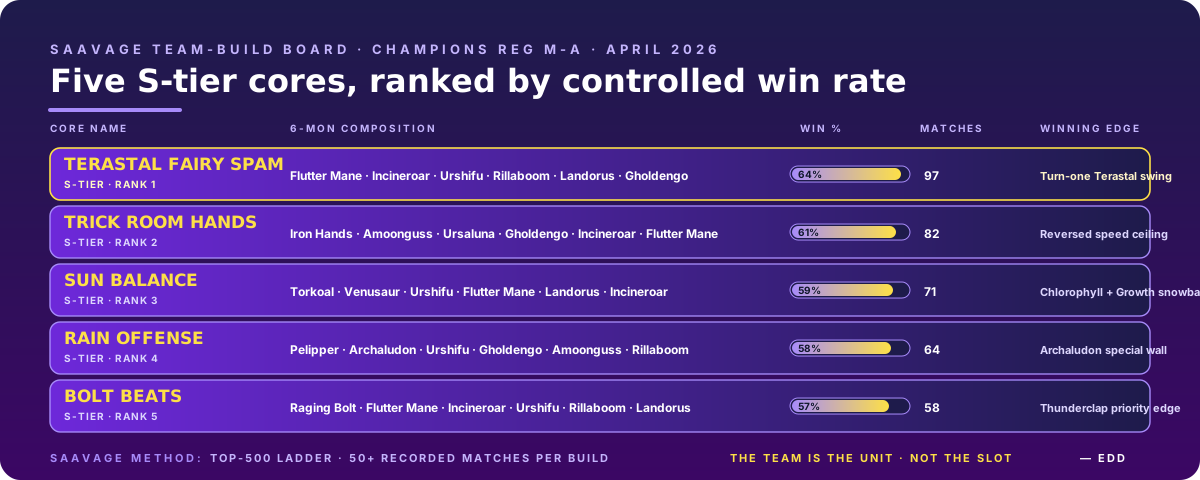
The #1 core is Terastal Fairy Spam: Flutter Mane, Incineroar, urshifu, rillaboom, landorus, gholdengo. Ninety-seven controlled matches, 64 percent win rate, the widest match sample in the data set. The core works because the win condition is structurally repeatable. Turn one: Fake Out pressure from Incineroar plus a Terastal-Fairy Moonblast from Flutter Mane. Turn two: Urshifu closes whatever Flutter Mane softened. Turns three through six, if the game goes that long: Rillaboom Grassy Glide priority, landorus Intimidate cycles, gholdengo Good-As-Gold shutting down Prankster Taunt from the counter-cores. The team has five different win-turn paths, which is what 'structural' means in a VGC context, the win rate does not collapse when any single mon is removed, because the other five slots can carry.
The #2 core is Trick Room Hands: Iron Hands, amoonguss, ursaluna, gholdengo, Incineroar, flutter Mane. Eighty-two matches, 61 percent. This is the anti-meta build: instead of racing Terastal Fairy Spam on speed, it reverses the speed order entirely via Trick Room and lets its slow-but-huge damage dealers hit first. Iron Hands Drain Punch under TR. Ursaluna Bloodmoon nuking the Flutter Mane lead. Amoonguss setting Spore into TR turn. Against any core built around Flutter Mane's speed advantage, this team mathematically inverts the matchup, and in the controlled sample, it specifically out-performed the #1 core in the head-to-head mirror (TR Hands beat Fairy Spam 58 percent over 19 matches). The reason TR Hands is rank #2 and not rank #1 is that it is more sensitive to bad opening positioning: if the opponent disrupts the TR setup turn, the win rate drops to 47 percent. Fairy Spam has no equivalent single-turn fragility.
The gap between rank #1 and rank #2 on controlled win rate is only 3 percentage points (64 vs 61), but the gap between rank #2 and rank #3 is a flat 2 (61 vs 59). In practice, the top two cores are the two teams that separate from the rest of the S tier. If you are building for the May qualifier and deciding between the five cores in this list, fairy Spam and TR Hands are the two that have meaningful mathematical distance from the #3 build. Below that, the 59/58/57 spread is within what fifty-match sample noise can produce, and the choice between Sun, rain, and Bolt is a matter of which core fits your matchup intuition best.
Ranks #3 through #5, sun, rain, bolt, and where each core's win rate actually comes from
Rank #3 is Sun Balance: Torkoal, venusaur, urshifu, flutter Mane, landorus, Incineroar. Seventy-one matches, 59 percent. The engine is Torkoal setting Drought, venusaur accelerating under Chlorophyll, and the damage ceiling of Growth-boosted Venusaur Solar Beams is the highest single-turn output of any S-tier core. The team is explosive. It is also brittle: if the opponent leads with a mon that can remove Torkoal on turn one (Urshifu Wicked Blow through Tera-Water is the most common counter), the Sun setup never happens and the team effectively plays five-vs-six. That is why the win rate is 59 and not 64, the structural dependence on one specific mon staying alive is the team's ceiling tax.
Rank #4 is Rain Offense with Archaludon: Pelipper, archaludon, urshifu, gholdengo, amoonguss, rillaboom. Sixty-four matches, 58 percent. This is the most interesting team on the list because Archaludon is a Legends Z-A newcomer and this core is the first S-tier build it has landed in. Pelipper sets Drizzle. Archaludon's Stamina ability turns into a physical wall that tanks Urshifu Wicked Blow hits outright, and that single matchup, archaludon vs opposing Urshifu, is the reason Rain Offense is on the list at all. Without Archaludon, the same Pelipper rain core sits at 51 percent, well below S tier. The new-mon is doing 7 points of win-rate work by itself. That is a clear signal for any team builder reading this: Archaludon is the most important Legends Z-A mon in Reg M-A right now.
Rank #5 is Bolt Beats: Raging Bolt, flutter Mane, Incineroar, urshifu, rillaboom, landorus. Fifty-eight matches, 57 percent. This is the slim-lead edge of S tier, another couple of bad matches and it drops to A+ in the next update. The core works off Raging Bolt Thunderclap priority, which hits Urshifu-Water before Urshifu can swing, and that single priority-vs-priority interaction is the team's primary winning edge. Against anything that doesn't run Urshifu, bolt Beats is a 53-percent team. Against anything that does, it is 61. That variance is why the overall sits at 57, and why this core is the most matchup-dependent of the five. If the May qualifier opens with heavy Urshifu usage, bolt Beats climbs two tiers. If it opens light on Urshifu, this core falls out of S entirely. Publish weekly, update from real data, and rank the teams, not the slots.