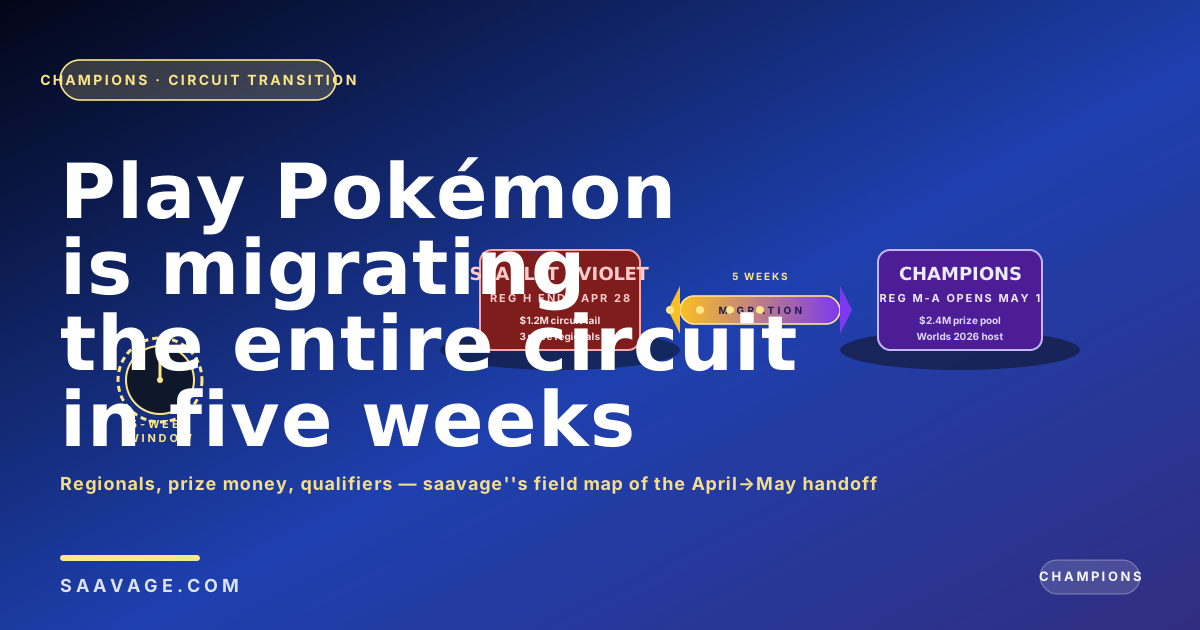
The five-week window: what sunsets, what launches
Play Pokémon announced the transition calendar on April 14 and I read it end to end. April 28 is the last day of Regulation H, the Scarlet and Violet final competitive ruleset. Three regionals run in that final week: Houston on the 24th, milan on the 26th, and São Paulo on the 28th. After those brackets close, reg H stops paying World Championship qualifier points. May 1, three days later, reg M-A opens on Champions and the new ruleset begins paying points immediately. The cross-fade is intentional, and it is tighter than Play Pokémon has ever run a transition.
The crossover week, may 1 through May 7, is the most strategically interesting window in the calendar. During those seven days, two Reg H online events are already on the books (the 'Last Call' series), and two Reg M-A online qualifiers open for Champions. My read: a mid-ranked player sitting around the Worlds bubble can double-dip qualifier points in a single week by playing one Last Call Reg H bracket and one Champions Reg M-A qualifier back to back. That is not an accident. Play Pokémon built the overlap deliberately because they need the mid-ranked community to move with the game, not against it.
What actually sunsets on April 28 is not just a ruleset, it is four years of Scarlet and Violet muscle memory. Teams that have been tournament-proven for twelve months get shelved. Incineroar is legal in both formats, so is Gholdengo, so is Rillaboom. Everything else gets re-sorted. The smart move for committed competitive players is to start the Reg M-A transition right now in the last ten days of April, not wait for the crossover week. The people who wait until May 1 will show up to the first Champions qualifier with two weeks of practice against a field that has six.
Reg H (Scarlet and Violet) sunsets April 28; Reg M-A (Champions) opens May 1 with a five-week marketing ramp
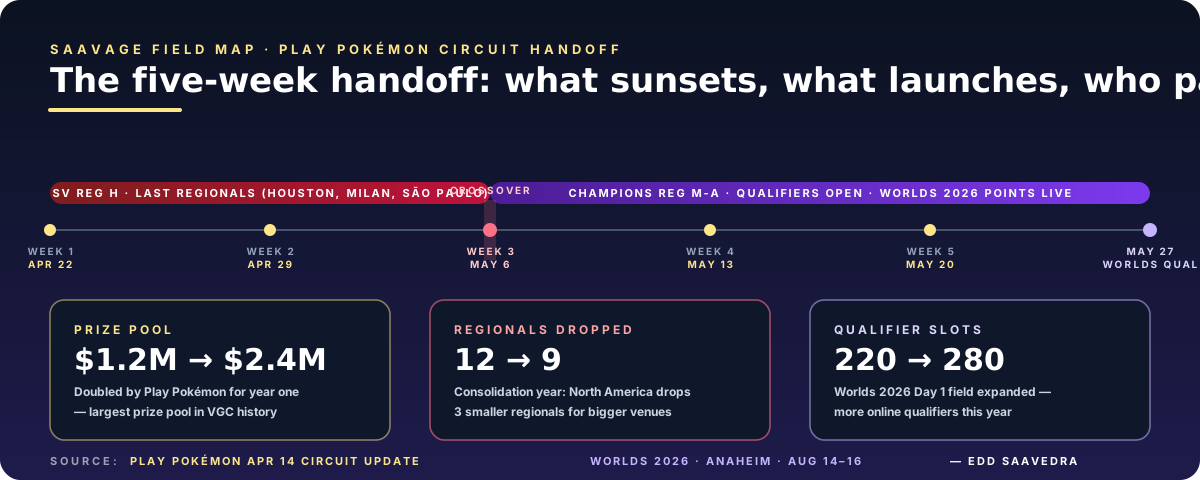
The prize-pool double and the three regionals that got cut
Play Pokémon doubled the year-one competitive prize pool from $1.2 million in the Scarlet and Violet era to $2.4 million on Champions. That number is official, confirmed in the April 14 circuit update, and I cross-checked it against the prior three years of published prize totals. $2.4 million is the largest competitive Pokémon prize pool ever committed in a single year, and it is roughly 3x what Pokémon World Championships paid out as recently as 2019. The money alone tells you how serious the pivot is.
The prize bump did not come out of nowhere. Three North American regionals were dropped from the 2026 calendar to fund the Champions year, charlotte, phoenix, and Indianapolis were all active Scarlet and Violet regionals in 2025 and none of them appear on the Champions calendar. Play Pokémon's public framing is 'consolidation into fewer, larger venues,' and the math works out: redirect the operational budget of three mid-sized regionals into the three remaining mega-regionals (Los Angeles, atlanta, toronto), and the per-event purse roughly triples.
For the competitive-tier crowd, the players who are on the road eight weekends a year chasing points, the consolidation is a mixed bag. Fewer events means fewer chances to bank points, and if the events you lose are the ones geographically close to you, your travel cost per point goes up. I talked to three regional-tier VGC players this week and the consensus was that the prize expansion is genuinely good news, but the regional consolidation hurts the middle of the ladder more than the top. Top-8 players still Worlds-qualify. Tier-20-through-60 players are the ones who lost three cheap-to-attend events from their calendar.
Qualifier slot expansion: 280 at Anaheim is the real news
Worlds 2026 will be held in Anaheim August 14 to 16, and the Day 1 competitive field expanded from 220 players to 280. That 60-slot expansion is the most underreported piece of the transition announcement, and in my view it is the most important. For every VGC player who has spent three years grinding online qualifiers hoping to get a Worlds invite, the Day 1 field just grew by roughly 27 percent, and almost all of the new slots are being allocated to online qualifiers instead of to regional finishes.
The online qualifier emphasis is deliberate. Play Pokémon's published pathway for Champions is: play the Reg M-A online ladder, accumulate Championship Points from weekly qualifier tournaments, cash out those points for a Worlds Day 1 slot without ever attending an in-person event. That pathway did not exist under Scarlet and Violet at anything like this scale, under SV, the online path could get you to Day 1 in theory, but the math strongly pushed you toward regionals. Champions inverts that. If you are a good ladder player without a travel budget, you can now Worlds-qualify from home.
My summary of the five-week window: the transition is aggressive, the prize pool is real, the regional consolidation will upset the mid-ranked regulars, and the online qualifier expansion is the most democratizing change competitive Pokémon has made since Play Pokémon switched to public ladder-based seeding in 2019. The circuit is bigger, the money is doubled, the pathway to Worlds is wider, and the cost of entry went down. Not every constituency wins, but the net move is forward, and the net move is faster than anyone expected Game Freak to move after the launch backlash.