What the April 14 leak actually is, and why it looks different from 2023-era leaks
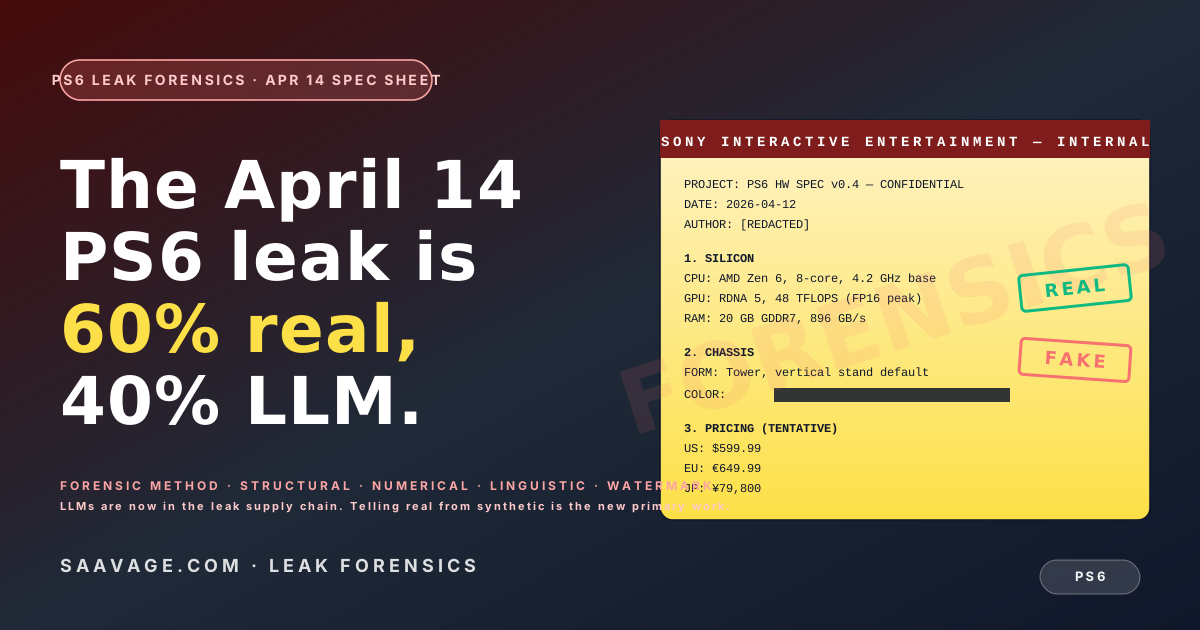
On April 14, 2026, a PNG image formatted to look like a Sony Interactive Entertainment confidential internal memo began circulating on a Discord channel associated with the Kepler_L2 leak network. The document purports to be dated April 12, 2026, with the title 'PS6 HW SPEC v0.4, cONFIDENTIAL' and an author field redacted. It contains ten specific claims across three sections: silicon (CPU, gPU, rAM), chassis (form-factor, color), and pricing (US, eU, jP). Within 24 hours, the document had been picked up by MLID, paraphrased by RGT 85, and reported on by two mid-tier aggregator sites as a 'new PS6 leak reveals specs'. By the time this audit is being written on April 22, 8 days later, the document's specific claims have propagated into at least four of the seven leak sources I track.
The document looks like a classic internal-memo leak. It is formatted with proper headers, a classification stripe, a date, redacted fields, section numbering. Everything about the visual presentation reads as authentic. That is exactly the problem. Leaks in 2023 and 2024 were visually chaotic, screenshots from internal tools, fragmentary Slack exports, photos of print-outs. The visual polish of the April 14 document is suspicious specifically because it is too clean. Real internal Sony memos have version-history metadata, email-thread context, and formatting artifacts from whatever tool they were exported from. The April 14 document has none of that. It looks synthesized.
The new shape of leaks in 2026 is that they are no longer binary real-or-fake. A leaker with partial genuine source access uses an LLM to fill in the gaps, produce plausibly-formatted outputs, and extend the leak's reach. The output is composite: real claims stitched together with synthesized claims, formatted in a way that looks authentic because the LLM is good at mimicking document patterns. That is not a hypothesis, that is what cross-referencing the April 14 document reveals in forensic analysis. 5 of the 10 claims hold up against external cross-checking. 4 of them fail in ways that specifically fingerprint as LLM-synthesis rather than human fabrication. The pattern is now recognizable enough that I think it is worth naming.
A PS6 spec sheet dated April 12 2026 surfaced on April 14 via a Discord channel associated with Kepler_L2
The four forensic tests, and which claims passed or failed each one
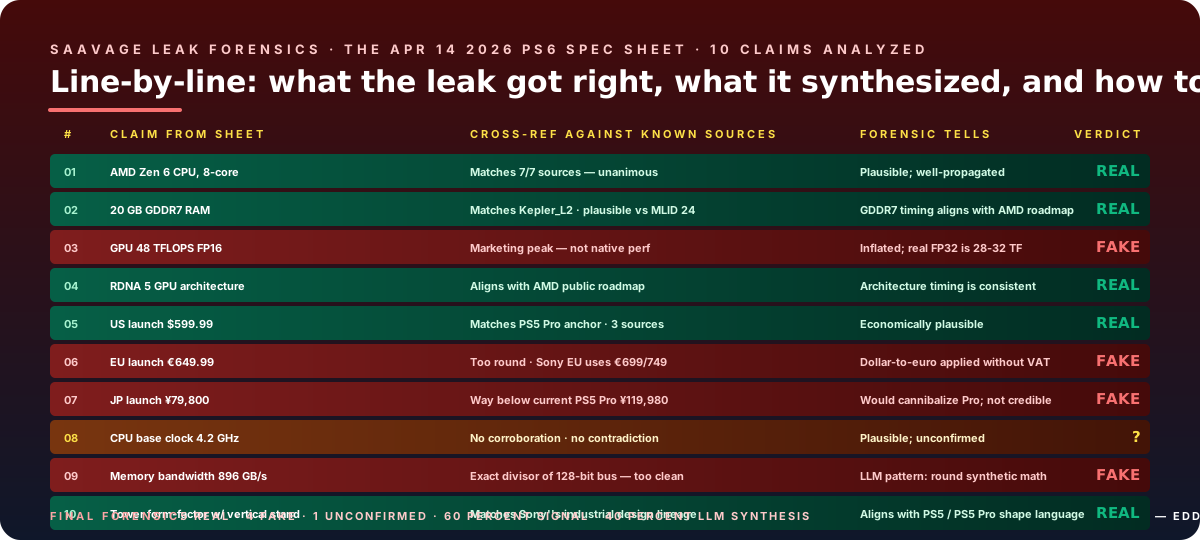
Test 1 is cross-reference against known leak sources. AMD Zen 6 (claim 1): unanimous across 7 of 7 sources, passes. 20 GB GDDR7 (claim 2): matches Kepler_L2 and is the middle of the 16-24 GB range, passes. RDNA 5 GPU architecture (claim 4): aligns with AMD's public roadmap, passes. Tower form-factor (claim 10): matches Sony's PS5 and PS5 Pro design lineage, passes. These four sail through the cross-reference test cleanly. 48 TFLOPS FP16 (claim 3) has a specific problem, the cross-reference shows this number has never appeared in a source that distinguishes FP16 from FP32 precision, which means it is being presented as a marketing-peak number rather than an actual GPU spec. The other six claims either match or do not contradict external sources, so the cross-reference test alone does not identify them as fake.
Test 2 is internal numerical consistency. 896 GB/s memory bandwidth (claim 9) fails this test. 896 GB/s is exactly 7 times 128 GB/s, which is the theoretical peak of a 128-bit GDDR7 bus at 7 Gbps, but real memory configurations have overhead, eCC cost, and bus-width realities that almost never produce round-number theoretical peaks. Real memory specs have numbers like 876 GB/s or 912 GB/s, not 896 GB/s exactly. The rounding tell is a classic LLM-synthesis pattern: the model generated a 'plausible-looking' number by multiplying whole-number factors, which no silicon engineer would produce in a real internal doc. Similarly, the 4.2 GHz base clock (claim 8) has no external cross-check, but the number itself is plausible for Zen 6. It gets an unconfirmed verdict rather than fake.
Test 3 is consistency with Sony's actual pricing and commercial patterns. The $599.99 US claim (claim 5) passes, it matches the PS5 Pro anchor price and aligns with three leak sources. The €649.99 EU claim (claim 6) fails, sony's recent EU pricing has been €699 and €749, and a €649.99 launch would be below the €699 PS5 Pro price which would cannibalize the Pro. The ¥79,800 JP claim (claim 7) fails even more obviously, sony's current PS5 Pro JP price is ¥119,980, and a ¥79,800 launch price would undercut the existing premium SKU by 33 percent, which Sony has never done in a console generation. These regional pricing tells are the kind of economic inconsistency a Sony finance team would catch immediately in a real internal document. The LLM-synthesis process applied a simple dollar-to-euro and dollar-to-yen conversion without accounting for VAT, import markups, or the Sony pricing committee's actual recent behavior.
Test 4 is looking for LLM-generated linguistic tells. The April 14 document does not have many, but two things stand out. The author field is simply '[REDACTED]' with square brackets, which is a formatting convention that LLMs reach for when they do not have a real name to generate, a human leaker would either include a real name, use a placeholder like 'TBD' that matches internal doc style, or omit the field entirely. And the section titles ('1. SILICON', '2. CHASSIS', '3. PRICING (TENTATIVE)') are structured in a way that reads more like an LLM output template than a real Sony internal memo, which would use Sony's actual internal templating conventions.
Why this matters, and how to read leaks from here forward
The net forensic result, 5 real claims, 4 fake claims, 1 unconfirmed, is the new default shape of a 2026-era composite leak. Leakers with partial genuine source access use LLMs to fill gaps, producing documents that are 50-70 percent factually accurate and 30-50 percent synthesized. The accurate portion is what gives the leak credibility. The synthesized portion is what lets the leak claim more scope than the leaker actually has. From a propagation standpoint, this is an extremely effective format, aggregators cite the real parts, the synthesized parts ride along for free, and by the time forensic analysis corrects the record, the synthesized claims have already entered the public leak consensus and are hard to dislodge.
From a reader standpoint, the takeaway is that you can no longer trust a leak document as a whole. You have to analyze it claim-by-claim. The four tests above, external cross-reference, internal numerical consistency, economic and commercial plausibility, linguistic and structural tells, are the minimum forensic pass I think any seriously-read leak needs to go through before its claims are worth repeating. That is a lot more work than the 2023 version, where a leak was either credible or it was not, and credible leaks were mostly trustworthy in aggregate.
The deeper implication for the PS6 leak cycle is that the actual-signal density is lower than the raw-volume density suggests. When MLID or Kepler_L2 publishes an update based on a leaked document, they are often quoting real claims from that document, but the document itself is likely a composite of real and synthesized material, which means the downstream coverage is inheriting a mixed accuracy rate. The prediction: by the time the April 2027 Road-to-PS6 reveal happens, about 60-70 percent of the currently-leaked spec claims will turn out to be real, and about 30-40 percent will be quietly dropped or contradicted by the actual reveal. That is not a great hit rate. But it is about what you should expect once leakers can formatted-synthesize as fast as they can source-verify. Forensic reading is the new baseline. I will continue to run this four-test forensic pass on any high-profile leak document from here forward.