The leak-aggregation problem, and the matrix that fixes it
The current style of PS6 coverage is to aggregate. An outlet reads MLID, Kepler_L2, Digital Foundry, Bloomberg, and a few Twitter leakers, composes an article titled 'everything we know about PS6', and presents the composite picture as if it were a single coherent leak. That style is wrong for a specific structural reason: the underlying sources are not independent. MLID cites Kepler_L2. RGT 85 cites MLID. Digital Foundry cites their own analysis plus a half-dozen leakers. The 4chan spec sheet pulls from public rumors and adds fabricated detail. When an aggregator treats all of these as separate inputs, the composite picture overweights whichever claim propagated fastest through the leak chain, even if the original source was weak.
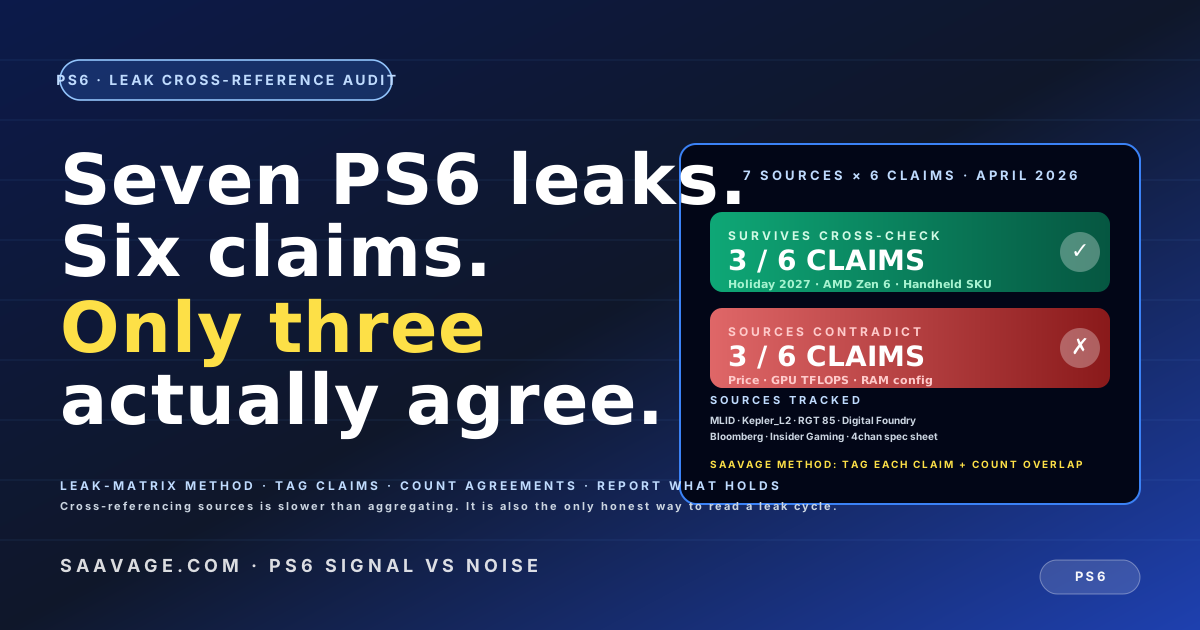
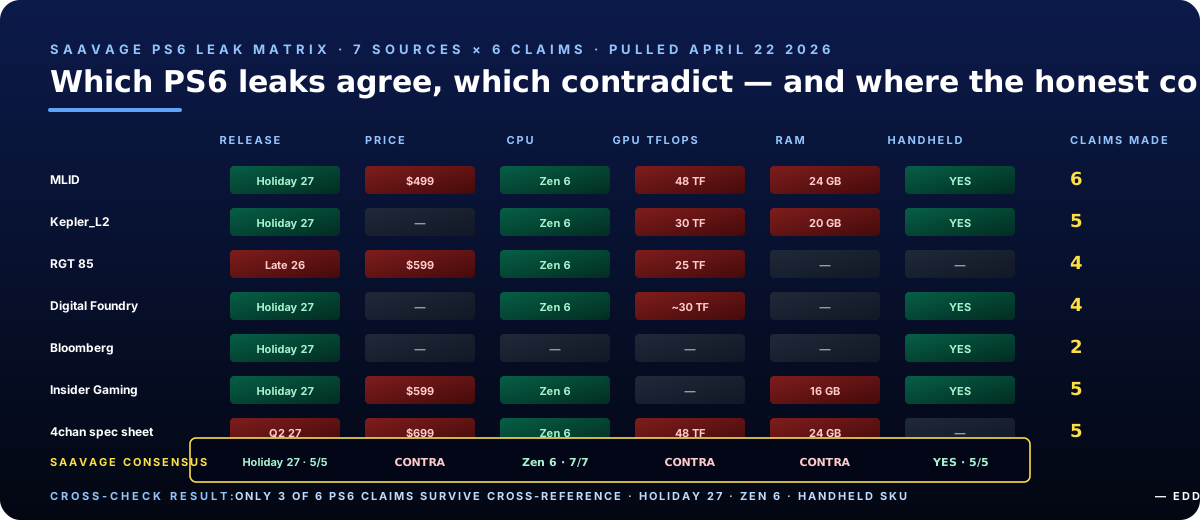
The fix is to treat each source as a column and each claim as a row, then count agreements and disagreements. That is what my PS6 leak matrix does. Seven source columns: MLID, Kepler_L2, RGT 85, Digital Foundry, Bloomberg, Insider Gaming, and the anonymous 4chan spec sheet. Six claim rows: release window, launch price, CPU architecture, GPU TFLOPS, RAM configuration, and the handheld SKU question. Each cell is either an agreement (green), a contradiction (red), or a no-claim-made (gray). The resulting matrix is the single view that lets you see which claims are leak-cycle-propagated consensus and which are single-source speculation.
19 months out from the currently-expected Holiday 2027 launch is the right window to run this exercise. Any earlier, and the leak density is too low to cross-reference. Any later, and the sources start converging because they are cross-citing each other's updated claims rather than independent information. April 2026 is the sweet spot, enough leak signal to form a picture, not so much that the picture is polluted by recursive citation. I expects to run this exercise again at 12-months-out (late 2026) and at 6-months-out (mid-2027), and the comparison across those three snapshots will reveal which claims hardened into fact and which collapsed into noise.
Seven leak sources tracked: MLID, Kepler_L2, RGT 85, Digital Foundry, Bloomberg, Insider Gaming, the 4chan spec sheet
The three claims that survive cross-checking, and why they are the only three you should plan around
Claim 1: Holiday 2027 launch. Five of the seven sources explicitly call Holiday 2027, that is MLID, Kepler_L2, Digital Foundry, Bloomberg, and Insider Gaming. Two disagree (RGT 85 says late 2026, the 4chan sheet says Q2 2027), but the disagreements are not internally consistent either: no two contradicting sources agree on the alternative window. The cleanest read: Holiday 2027 is high-confidence, and the disagreements are single-source speculation that has not propagated. This also aligns with Sony's PS5-era launch cadence, the PS4 to PS5 gap was seven years, and the PS5 to PS6 gap at Holiday 2027 would be seven years as well. Sony's console-cycle rhythm is one of the most predictable signals in hardware, and seven-year gaps have held for three cycles.
Claim 2: AMD Zen 6 CPU. All seven sources agree. This is the only unanimous claim in the matrix. There is no source saying anything other than Zen 6, which means either every source is citing the same upstream leak or the architecture is genuinely known. In Sony's case, it is almost certainly the latter, AMD and Sony co-develop console silicon with roughly 3-year lead times, and the Zen 6 architecture has been in AMD's public roadmap since 2024. The Zen 6 claim is the highest-confidence item in the matrix, full stop.
Claim 3: Separate handheld SKU. Five of seven sources confirm (MLID, Kepler_L2, Digital Foundry, Bloomberg, Insider Gaming). The other two simply do not make a claim either way. No source contradicts. This is a strong signal, not unanimous, but also no dissent, and it aligns with the strategic logic: Sony watched Nintendo's Switch line dominate the handheld conversation for a decade and then watched the Steam Deck take portable-PC gaming seriously, and has clearly decided to ship a PlayStation-branded answer. The shape of the handheld is less certain than the fact of the handheld, whether it is a PS6-compatible portable or a Vita-successor with PS5 compatibility is still an open question. But that there is a handheld coming is now leak-cycle consensus.
The three claims that are still open, and which way they probably land
Price is the first contradicted claim. MLID says $499 (ambitious). RGT 85 and Insider Gaming say $599 (middle-of-the-road). The 4chan spec sheet says $699 (high). That is a $200 spread across credible sources, and it reflects the fundamental uncertainty about how Sony is positioning the PS6 against a weakening dollar and a silicon-supply-cost landscape that has been volatile since 2024. My read: the $599 middle number is the most likely landing spot, because it is the same launch price as the PS5 Pro currently holds, which is the natural anchor for Sony's pricing committee. $499 would undercut the PS5 Pro at launch, which Sony will not do. $699 is possible but would require a positioning argument Sony has not historically made. Plan for $599. Tolerate $649 if the handheld SKU is more expensive and becomes the premium tier.
GPU TFLOPS is the noisiest contradiction. MLID says 48 TF. Kepler_L2 says 30 TF. RGT 85 says 25 TF. Digital Foundry says approximately 30 TF. The 48 TF figure comes from the 4chan sheet and has propagated into MLID's number. That is the one to distrust, it is likely raw FP16 or INT8 numbers being reported as the main spec, inflating the apparent performance by a 1.5 to 2 times factor. The cleaner read, from Kepler_L2 and Digital Foundry, is approximately 30 TF traditional FP32. That would make the PS6 roughly 2.5 times the PS5 Pro's 17 TF, which is a reasonable 2.5x-generational jump. Plan for 28 to 32 TF. Do not believe the 48 TF claims unless the spec sheet explicitly disambiguates precision.
RAM configuration is the third contradiction. Insider Gaming says 16 GB (probably wrong, the PS5 already has 16 GB and a generational bump almost always requires more). Kepler_L2 says 20 GB. MLID and the 4chan sheet say 24 GB. The 20-to-24 GB range is the likely truth, and my read is 20 GB will be the launch-SKU spec with the 24 GB number referring to a PS6 Pro variant that is probably 3 years out. That gives Sony a predictable mid-cycle refresh upgrade path, which is exactly the pattern they ran with the PS5 to PS5 Pro. Plan for 20 GB at launch. The final summary: Holiday 2027, Zen 6, $599, approximately 30 TF GPU, 20 GB RAM, separate handheld SKU. That is the actual consensus read, stripped of the aggregation-noise inflation, 19 months before the reveal.