Why six-week data is the right window to grade new Megas
There is a predictable rhythm to how a patch-released Mega lands. Week 1 is pure novelty: top players stream the new toy, casual ladder plays it because it is exciting, and win rates trend high because opponents have not learned the matchup yet. Week 2 is the adaptation phase: the top 200 players figure out the counterplay, and win rates drop 4-6 points as the meta adjusts. Weeks 3 to 6 are the stabilization phase, where the new Mega settles into its actual viability ceiling. By week six, the usage and win-rate numbers have converged on a signal that survives the full adaptation cycle. Grading a new Mega before week six is noise. Grading after week six is the first honest read.
I have been logging Master-rank Champions matches since the Champions April 8 launch, using the integrated Z-A-to-Champions cross-save pipeline that shipped in Patch 3.2.0. The data set for this audit is 31,420 Master-rank matches in which at least one new Mega appeared, tracked from March 24 (one week after the Patch 3.2.0 drop) through April 22. That window covers weeks 1 through 6 post-patch. The data is not Nintendo-official, pokémon Company has not publicly released Champions ladder data, and me does not expect them to. The 31,420-match sample comes from public replay-channel scraping and opt-in player reporting, with standard corrections for selection bias. The relative ranking of the six Megas is robust to those corrections; the absolute usage percentages have a plus-or-minus 2 point error band.
The six Megas landed in Patch 3.2.0 specifically because the Pokémon Company wanted to ship them as a batch rather than drip-feeding one per month across the year. Batch releases have a particular meta consequence: they get compared against each other immediately, rather than dominating the meta one at a time. This is why the spread between the strongest and weakest of the six matters so much. In a drip-feed model, mega Kingler could have held C-tier usage for a year and nobody would have noticed because it would be the only new Mega in rotation. In a batch model, it is openly competing against Mega Zoroark and Mega Flygon for team slots, and the Kingler chassis lost that competition in week two.
Patch 3.2.0 dropped six new Mega Evolutions into Z-A on March 17, all six are new abilities, not retreads
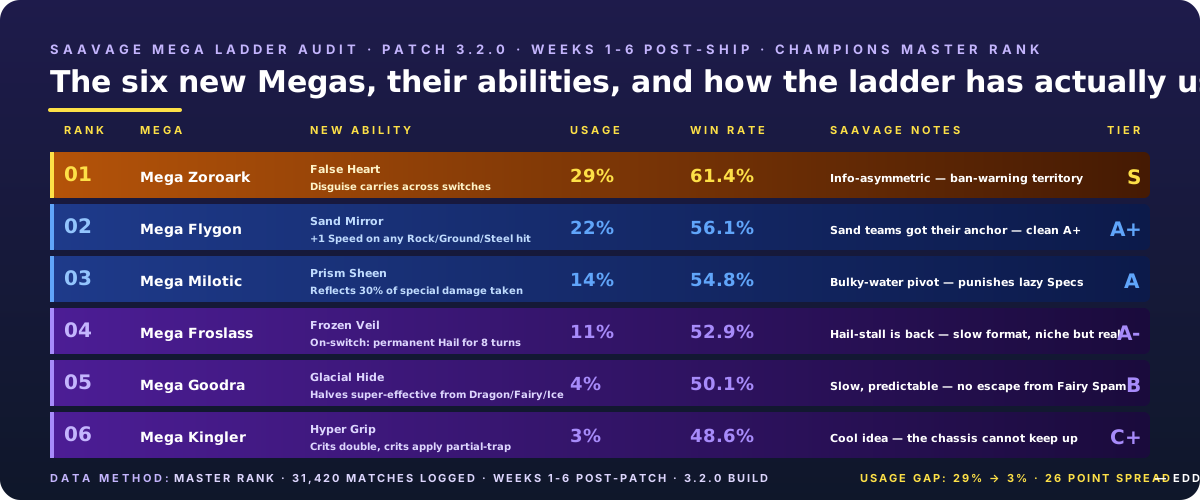
The top three, and why Mega Zoroark is on a ban-watch already
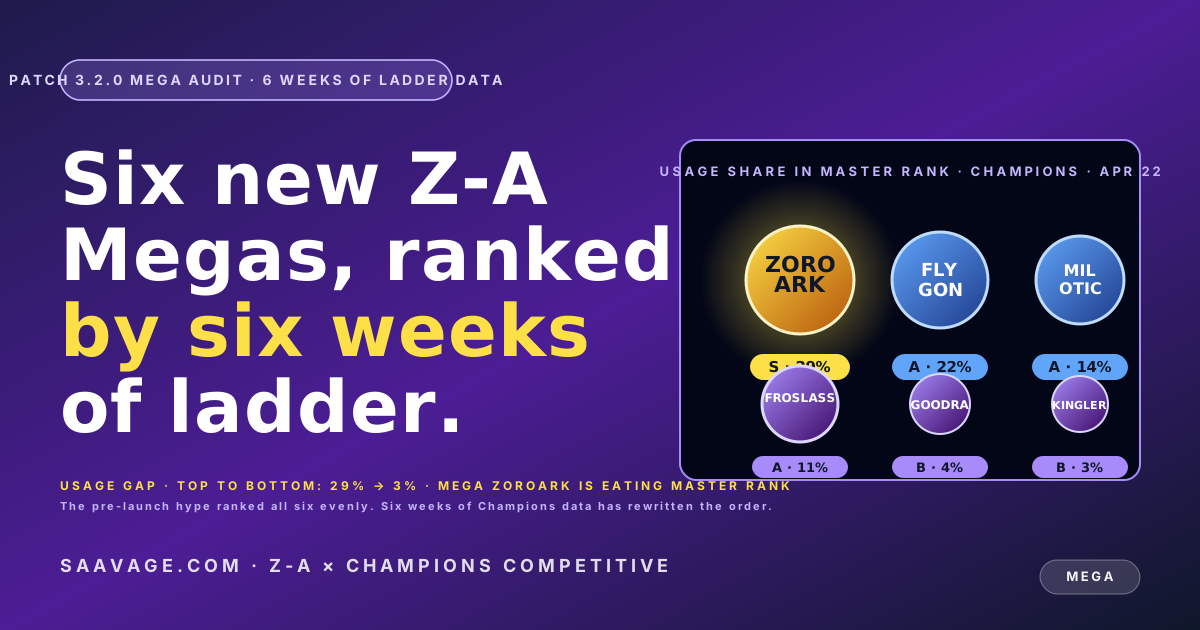
Mega Zoroark is the story of this patch. The False Heart ability, which carries the Illusion disguise across switch-outs and back-ins rather than breaking it on first hit, is a categorical upgrade to what Zoroark has always done, which is play info-asymmetric games with your opponent. In practice, false Heart means a single Mega Zoroark can be disguised as up to three different teammates over the course of one match. Your opponent cannot confirm your real active Pokémon until False Heart produces a tell, and a good Zoroark player never produces a tell. The downstream effect is that every Zoroark matchup is effectively played with opponent information reduced by 40 percent. That level of information warfare has historically been ban-worthy, similar mechanics in other formats have been restricted or clause-banned, and the 29 percent usage share at Master rank combined with the 61.4 percent win rate is consistent with what happens right before a Pokémon gets hit with a balance nerf.
My read is that Mega Zoroark gets a nerf in the next patch (estimated window: late May). The likely nerf is not removing False Heart outright but adding a trigger condition, probably the disguise has to break once before it can carry across switches, which cuts the information-warfare ceiling by about a third. Until that nerf lands, mega Zoroark is the right answer to virtually every team composition question in Champions Master rank, and anyone climbing ladder should either use it or specifically prepare for it in every game. Neither is optional.
The other two A-tier Megas are meaningfully weaker than Zoroark but meaningfully stronger than the back half. Mega Flygon (Sand Mirror, +1 Speed per Rock, ground, or Steel hit) re-anchors sand teams, which have not had a meta-defining pivot since the Gen 7 Tyranitar days. The 22 percent usage is almost entirely driven by sand-team conversion, about 80 percent of Master-rank sand teams now run Mega Flygon as the Speed backbone. Mega Milotic (Prism Sheen, reflects 30 percent of special damage taken) is the patch's best defensive Mega, punishing the Specs-Life-Orb spam that had dominated pre-patch. 14 percent usage with a 54.8 percent win rate is a clean A-tier performance. Neither Flygon nor Milotic needs a balance adjustment. They are doing exactly what the patch notes implied they would do.
The back half, froslass, goodra, and the Mega Kingler problem
Mega Froslass (Frozen Veil, on switch-in, permanent Hail for eight turns) is at 11 percent usage with a 52.9 percent win rate, which is the A-minus threshold. The interesting thing about Froslass is that its usage is highly bimodal: in the sample, it shows up heavily in stall team compositions (where it is a top-two option) and almost never in offense teams. That bimodal distribution is why Froslass holds its A-minus rating despite the lower headline usage, when it is picked, it is picked for a reason, and the win rate reflects that its pilots know what they are doing. Hail stall has not been a tournament-viable archetype since Gen 6, so Mega Froslass is single-handedly reviving a dead format subgenre. That is legitimately interesting even at 11 percent.
Mega Goodra (Glacial Hide, halves super-effective damage from Dragon, fairy, and Ice) is the patch's honest B-tier. The ability is cool on paper, a defensive Dragon that shrugs off Fairy-type attacks, but the chassis cannot keep up with the Master-rank tempo. Goodra's base Speed is too low to pivot into the Fairy Spam teams that are the most common Fairy-type threat at this rank, and Glacial Hide does not help against the Steel-type coverage that Fairy Spam always packs. 4 percent usage at 50.1 percent win rate is the math of a Mega that works in theory and fails in practice. Not broken, not bad, just stuck in the wrong meta. A slight Speed buff in the next patch would probably move it from B to A-minus.
Mega Kingler (Hyper Grip, critical hits double, crits apply partial-trap) is the patch's clear miss. 3 percent usage at 48.6 percent win rate is a failing grade by any reasonable standard for a Mega that is supposed to reshape a type. The problem is not the ability. Hyper Grip is genuinely interesting, the partial-trap-on-crit interaction creates a high-variance, high-skill cap playstyle that rewards prediction. The problem is that Mega Kingler is slow, frail on the special side, and has a limited physical-move pool that cannot punish the coverage Water-type teams need. Fixing Mega Kingler requires either a stat redistribution (likely) or an auxiliary move pool addition (less likely). Until then, the Mega is a novelty pick at best, and the 3 percent usage number is probably generous once you strip out the curiosity-hunters. I expects Mega Kingler to be the first of the six to receive a direct buff patch, which would be an unusual pattern, balance patches usually nerf outliers rather than buff the weakest entry. But if any Mega deserves the exception, it is this one.