Overview
Google's Gemini reached 750 million monthly active users by early April 2026, up from 450 million at the start of the year. The growth is partly organic and partly structural: Gemini is embedded in Android, in Google Search through AI Overviews, and in Workspace, which means hundreds of millions of people encounter it without explicitly seeking it out. The standalone Gemini app is a different story, and the numbers there are harder to disentangle from the ambient integration.
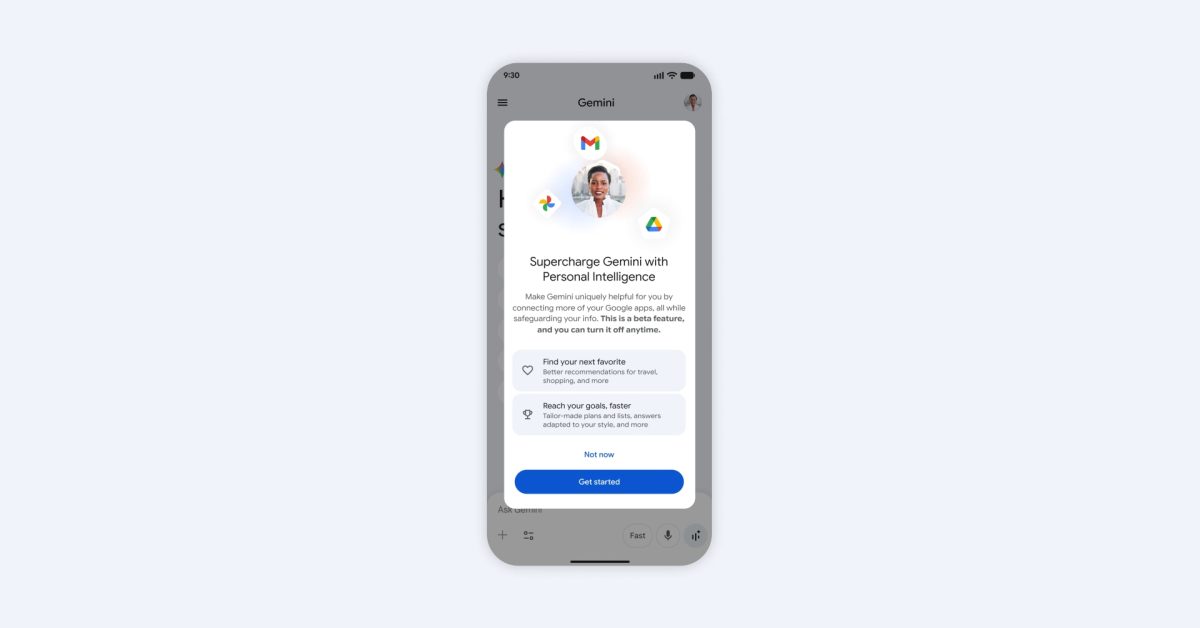
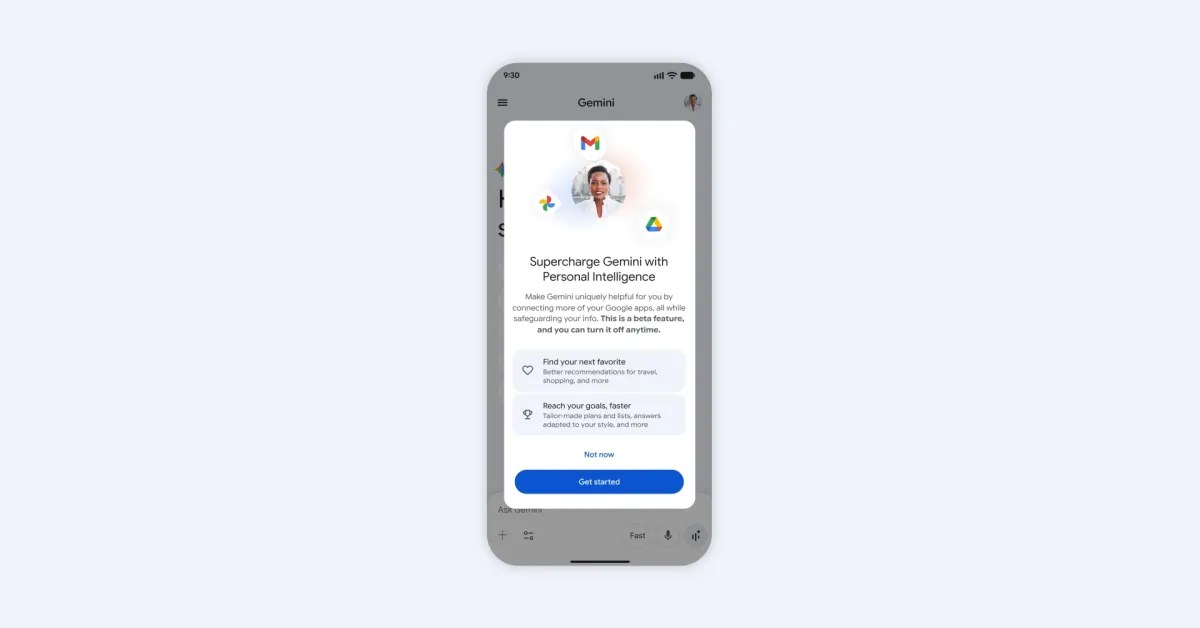
The milestone comes alongside the global rollout of Personal Intelligence, a feature that launched in the United States on March 27 and expanded internationally on April 14. Personal Intelligence connects Gemini to Gmail, Calendar, Drive, Workspace, Photos, YouTube, and Maps, giving the model direct access to a user's most personal digital context. The pitch is that Gemini becomes genuinely useful because it knows your life, not just the internet.
750M monthly active users, 8M paid enterprise seats
How Personal Intelligence Works
Personal Intelligence works by pulling structured data from connected Google services and making it available to Gemini at query time. Ask where you're staying in Tokyo next week and it pulls the hotel confirmation from Gmail. Ask what your week looks like and it synthesizes Calendar events with relevant Drive documents. It can surface purchase history, receipts stored in Drive, warranty information, and photos tagged to specific locations via Maps.
The feature is opt-in and rolls out to paid subscribers first. Gemini Plus at $7.99 per month and Pro at $19.99 per month get access in the first wave. Ultra subscribers at $249.99 per month have had early access since the US launch. Free tier users are on a waiting list with no committed timeline. Google has framed the tiered rollout as infrastructure management, which may be true. It also creates a clear upsell moment for every free user who reads about the feature.
The practical experience, based on early user reports, is uneven but impressive in specific cases. Travel planning across multiple trips stored in Gmail is reportedly strong. Calendar context for scheduling is reliable. Synthesis across Drive documents is good when files are well-organized, weaker when they are not. The model is only as useful as the data it can find, which means heavy Google users benefit more than light ones.
Gemini's Broader Position
Beyond the consumer numbers, Google has built a substantial enterprise position. Gemini has 8 million paid enterprise seats and is deployed at over 120,000 companies. Ninety-five percent of the top 20 global SaaS companies use Gemini in some capacity. Thirteen million developers have integrated Gemini into applications. These numbers give Google a foundation that pure consumer AI products cannot match.
On the model side, Gemini 3.1 Pro currently ranks first on 12 of 18 reasoning benchmarks. The technical credibility is real. The question is whether benchmark performance translates into the kind of everyday usefulness that generates loyalty. Gemini has had a complicated few years: early demos that overpromised, inconsistent quality across regions, and a perception problem in developer communities where OpenAI and Anthropic have stronger brand recognition.
Personal Intelligence is Google's best answer to that perception gap. It is a capability that OpenAI and Anthropic structurally cannot match today. Neither company has the breadth of first-party data that Google's services generate. If the feature works well at scale, it creates a genuine moat.
The Privacy Tradeoff Users Are Being Asked to Make
Connecting your email, calendar, photos, and purchase history to an AI model is a significant privacy decision, and Google is aware that not everyone will make it comfortably. The opt-in design is meant to address that. Users must explicitly enable Personal Intelligence, grant permissions for each service, and can revoke access at any time. Google has published documentation on what data is accessed, when, and how it is retained.
The comparison to Gmail's original launch is instructive. When Google introduced advertising in Gmail in 2004, the idea of a company scanning your email to serve ads was genuinely controversial. Privacy advocates called it surveillance. Regulators raised questions. Users signed up anyway, because the product was useful. Over time, the discomfort faded and email scanning for ads became normalized. Personal Intelligence is a similar moment. The privacy cost is real. The utility benefit is also real. Most users will make the same calculation they made with Gmail.
What is different now is the regulatory environment. GDPR in Europe, CPRA in California, and a patchwork of other privacy laws impose requirements that did not exist in 2004. Google has built Personal Intelligence with geographic controls: features available in the US may be restricted or absent in the EU depending on data processing requirements. The tiered global rollout reflects legal complexity as much as infrastructure capacity.
Why Personal Context Is the Next AI Moat
The AI assistants that will win long-term are the ones that know the most about you specifically. General intelligence, the ability to answer any question about any topic, is becoming a commodity. Every major model is now capable enough for most general tasks. The differentiation is shifting to personal relevance: can the AI help you with your situation, your history, your constraints, your preferences?
Personal context creates a data network effect that differs from traditional network effects. It is not about having more users; it is about each individual user generating more useful signal over time. The longer you use Personal Intelligence, the better the model understands your communication patterns, your schedule preferences, and the way you structure information. That compounding value makes switching costly. Moving from Gemini to a competitor means starting the personalization process from scratch.
OpenAI has Memory features and Microsoft has Copilot integrated with Microsoft 365. But neither has the breadth of Google's data surface. Photos, Maps location history, YouTube watch history, and Gmail search behavior together paint a picture of a person's life that is qualitatively richer than what a productivity suite can infer. This is Google's structural advantage in the AI era, and Personal Intelligence is the first product that seriously attempts to use it.