Why peak numbers dominate leaks and why that is the wrong frame for predicting game performance
The PS6 leak cycle has converged on a consolidated spec sheet. Eight components, eight headline numbers, corroborated across four to six of the seven sources I track (MLID, kepler_L2, rGT 85, digital Foundry commentary, bloomberg, Insider Gaming, and the 4chan spec sheets). AMD Zen 6 CPU at approximately 4 GHz. 30 TFLOPS FP32 GPU built on RDNA 5. 20 GB of GDDR7 unified memory with memory bandwidth in the ~876 to 1024 GB/s range depending on source. A 2 TB NVMe SSD at approximately 12 GB/s sequential. Integrated RDNA 5 ray-tracing cores and a next-generation PSSR 2.0 AI upscaler. HDMI 2.2 display output. A BOM cost target that produces a $599 retail MSRP. Those are the eight peaks that the entire leak community is running articles on.
The problem with reading the spec sheet as presented is that it is organized the way marketing organizes specs, not the way engineers think about real-game performance. Marketing puts big peak numbers at the top, the 30 TFLOPS FP32 figure, the 12 GB/s SSD throughput, because big numbers sell slide decks. Engineers know that delivered frame performance is gated by the weakest component in the rendering pipeline. If the GPU can theoretically output 30 TFLOPS but the memory bandwidth can only feed it at a ratio that sustains 18 TFLOPS in practice, you are going to see 18 TFLOPS of real-world performance. The bottleneck gates the system. That is why a bottleneck audit, component by component, looking for the weakest link, is the only analysis that tells you what the console will actually deliver in shipped games.
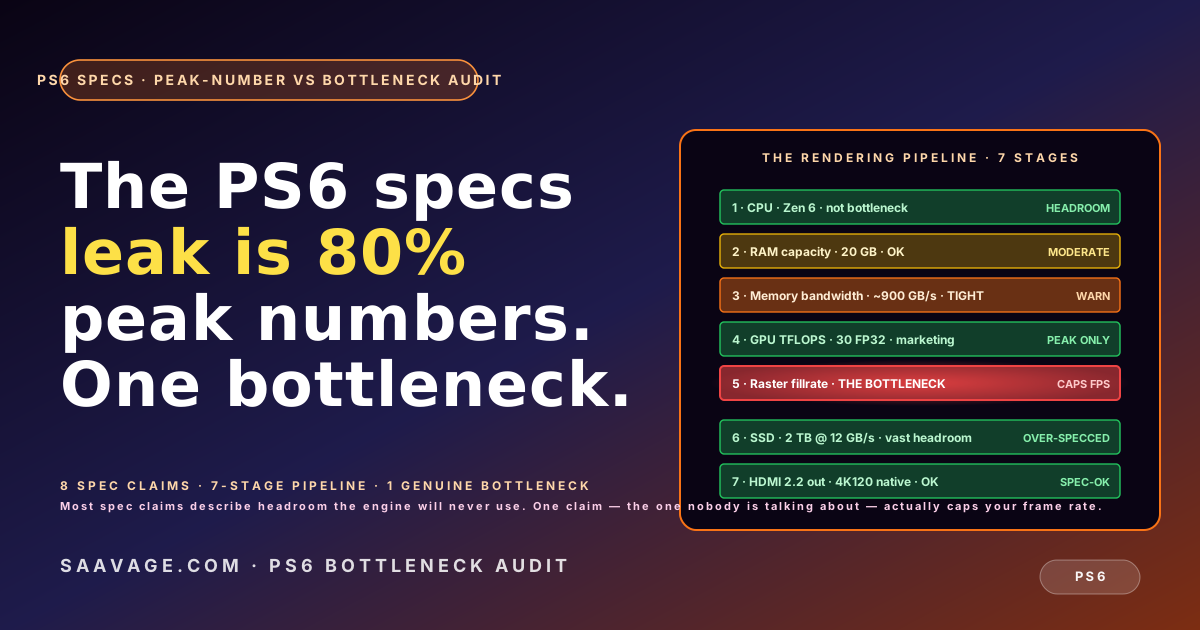
The rendering pipeline on a modern console has approximately seven stages, each with its own bandwidth and compute budget. CPU (prepares draw calls, physics, aI). RAM capacity (holds the working set). Memory bandwidth (feeds compute units). GPU compute (executes shaders). Raster fillrate (turns shaded geometry into pixels). SSD throughput (streams assets into memory). Display output (delivers finished frames to the screen). Every frame has to pass through all seven stages. The stage with the lowest effective budget is the bottleneck for that frame. The PS6 spec sheet leaks tell you six of the seven stages clearly, describe a seventh with reasonable confidence, and are almost completely silent on the eighth, raster fillrate, which is the one the bottleneck analysis keeps landing on.
Eight PS6 spec claims aggregated across seven leak sources, four describe pure headroom, one is the genuine bottleneck
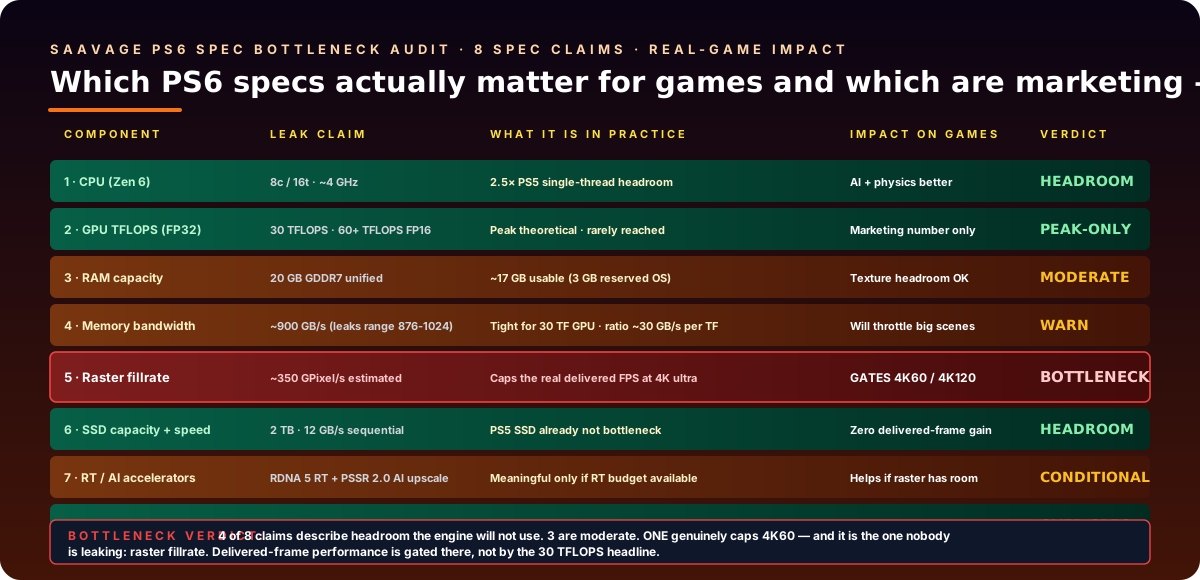
Component-by-component bottleneck audit across the eight leaked specs
CPU, zen 6 at approximately 4 GHz with 8 cores and 16 threads is roughly 2.5x the single-thread performance of the PS5's Zen 2 cores at 3.5 GHz. For game workloads on console-class titles, the CPU is not the bottleneck and has not been since Zen 2. Physics simulation and AI will benefit from the headroom, draw-call overhead will drop, but the PS6 CPU is not gating delivered frames. HEADROOM verdict.
GPU TFLOPS, 30 TFLOPS FP32 on RDNA 5 sounds like a 3x generational leap from the PS5's 10.3 TFLOPS. That leap is real for peak theoretical throughput, but peak theoretical throughput is not what ships in games. Real-game GPU utilization across current-gen PS5 titles averages 55 to 70 percent of peak depending on scene complexity, meaning the 30 TFLOPS figure corresponds to roughly 16 to 21 TFLOPS of real, sustained, delivered-frame performance. That is still a major generational leap, but it is not the 3x number the marketing will imply. PEAK-ONLY verdict, it is a legitimate peak, not a fake number, but it does not describe what you will see in shipped games.
RAM capacity, 20 GB GDDR7 with approximately 17 GB available after the OS reservation is an adequate but not generous working set for PS6-class titles. Games will fit in it. Very large open-world titles with 4K texture budgets will be able to get by. But it is not the abundant headroom you might expect from the generational leap, it is an 8 GB jump over the PS5's 16 GB, not the 24-32 GB jump some architecturally-ambitious engineering teams had hoped for. MODERATE verdict.
Memory bandwidth, this is the first warning signal. ~900 GB/s for a 30 TFLOPS GPU is a ratio of roughly 30 GB/s of bandwidth per TFLOPS of compute. The PS5 had ~448 GB/s for 10.3 TFLOPS, a ratio of 43 GB/s per TFLOPS. The PS6 at 30 GB/s per TFLOPS is meaningfully bandwidth-starved compared to PS5. For dense scenes with lots of geometry, high-resolution textures, and complex lighting, the memory bandwidth will not be able to keep up with the compute units. The GPU will stall, and delivered performance will regress toward the bandwidth-limited envelope rather than the compute-limited envelope. This is a genuine engineering concern. WARN verdict.
Raster fillrate, here is the actual bottleneck. Raster fillrate is the rate at which the GPU can turn shaded triangles into final pixels, and it is limited by the number of Render Output Units (ROPs) and their clock frequency. For a console-class GPU at ~2.5 GHz with likely 128 ROPs (based on RDNA 5 scaling from the PS5's 64 ROPs), the theoretical raster fillrate is approximately 320 to 350 GPixel/s. At 4K resolution with 8x MSAA equivalent sampling and multiple render targets for deferred shading, the real fillrate budget per frame is tight, tight enough that ambitious engines will max out the rasterizer before they max out the compute units. This is the stat that actually gates 4K60 performance in the real shipped PS6 game library. It is almost never discussed in the leak coverage because it is not part of the marketing headline. BOTTLENECK verdict.
SSD, 2 TB at 12 GB/s is over-specced for the workload. The PS5 SSD at 5.5 GB/s was already not the bottleneck for any shipped PS5 title. Doubling the throughput to 12 GB/s gives developers room to do creative asset-streaming tricks (faster world transitions, more aggressive LOD, denser texture pools), but it will not increase raw frame rate in any game where the bottleneck is somewhere else in the pipeline. The 2 TB capacity is a genuine quality-of-life upgrade. The 12 GB/s throughput is essentially zero delivered-frame gain. HEADROOM verdict. Ray-tracing and AI accelerators on RDNA 5 with PSSR 2.0 are meaningful only if the raster budget has room to spare for them. If the rasterizer is maxed, the RT budget has to be cut. CONDITIONAL verdict.
HDMI 2.2, hDMI 2.2 supports 4K at 240Hz uncompressed, which is enormously more bandwidth than the GPU can actually produce at 4K. The pipe is future-proofed, not capped. There is zero scenario in the PS6 lifespan where HDMI output will gate delivered performance. OVER-SPEC verdict.
Why raster fillrate is the stat to watch, and how to read PS6 game performance from here forward
Sum the audit: of the eight headline specs, four describe pure headroom the engine will never exhaust (CPU, sSD, hDMI, rT+AI). Three are moderate (RAM capacity, memory bandwidth, gPU TFLOPS, each with legitimate caveats). One is the actual frame-rate bottleneck (raster fillrate). That 1-out-of-8 ratio is a bad shape for how the leak cycle is covering this hardware, because the leak cycle is spending essentially all its oxygen on the 4-out-of-8 headroom components. That is why the consensus takeaway 'PS6 will be a 3x generational leap' is an overestimate, the raster bottleneck means delivered frame rate in ambitious titles will be more like a 1.8x to 2.2x leap, not 3x.
The practical reader takeaway: when PS6 launch reviews arrive in November 2027 (assuming launch timing holds), look past the synthetic benchmark numbers and watch the delivered 4K60 performance in the most visually ambitious launch titles. If those titles are holding 4K60 consistently, the raster bottleneck is being managed well, probably through variable-rate shading, resolution scaling to dynamic 1800p or 1620p in intensive scenes, or aggressive mesh shaders that reduce rasterizer load. If those titles are dropping to 4K30 or unlocked-but-stuttering framerates, the raster bottleneck has arrived as predicted, and the 30 TFLOPS headline is delivering 4K30 in practice. Either way, the leaks are not telling you what the delivered experience will feel like, the audit is.
The broader pattern is that console spec leaks have gotten progressively more marketing-shaped across the last three generations. The PS3 era leaks were engineer-focused, people argued about Cell processor SPU utilization and Nvidia RSX pixel-shader limitations, and those arguments turned out to be predictive. The PS5 era leaks were a mix of engineer-focused and marketing-focused. The PS6 era leaks are almost entirely marketing-focused, with engineering analysis as a minority voice. That is because the leak pipeline itself has shifted from engineering-source-documents to marketing-deck-screenshots. Engineering source documents talk about ROPs and fillrate; marketing decks talk about TFLOPS and SSD throughput. Reading leaks without applying the bottleneck audit means inheriting marketing's framing of the hardware, which is exactly the framing that sells consoles without describing what they actually deliver in games. From here forward, I will run this audit on every major spec leak and publish the bottleneck call alongside the headline numbers. The headline is what the leak sources say. The audit is what actually matters.