
Overview
The AI landscape has undergone a seismic shift. For years, we treated large language models (LLMs) as sophisticated text generators—tools that required constant human prompting for every single step. We built chatbots that could answer questions, but they couldn't act. They couldn't manage a project, research a topic across multiple platforms, and then synthesize a final report without a human hand guiding them through every single prompt.
Enter the era of the Managed Agent.
Autonomous AI agents represent the next frontier of artificial intelligence. They are not just sophisticated chatbots; they are digital workers. They receive a high-level goal—"Plan and book a business trip to Tokyo for under $3,000"—and they execute the entire plan: researching flights, checking hotel availability, comparing prices, and compiling a final itinerary, all without needing you to prompt them for the next step.
Understanding the Shift: From Chatbot to Autonomous Agent
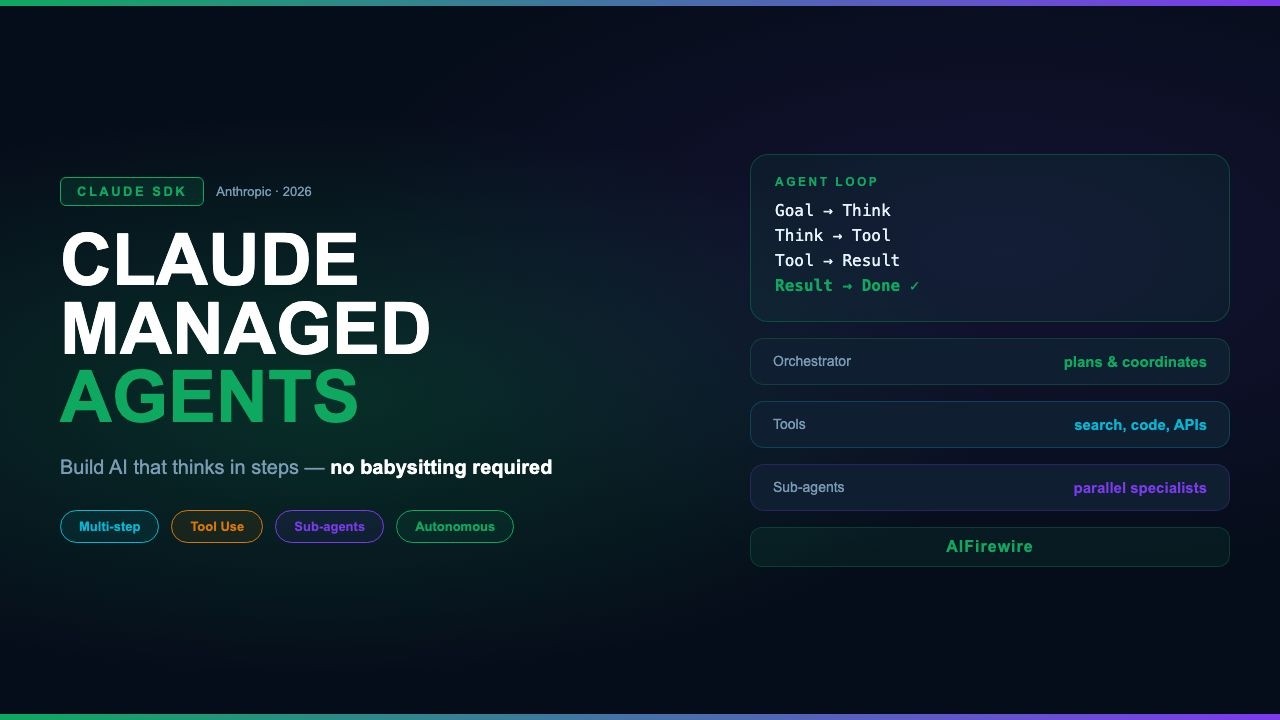
Understanding the Shift: From Chatbot to Autonomous Agent
To appreciate the power of managed agents, we first need to understand what separates them from traditional LLM applications.
A Chatbot is reactive. It waits for a prompt and provides a single, immediate response. Its workflow is linear: Input $\rightarrow$ Process $\rightarrow$ Output.
An Autonomous Agent is proactive and iterative. It receives a goal, creates a plan, executes the plan, evaluates the results, identifies failures, and then self-corrects until the goal is met. Its workflow is cyclical: Goal $\rightarrow$ Plan $\rightarrow$ Execute $\rightarrow$ Observe $\rightarrow$ Refine $\rightarrow$ Goal Achieved.
The Architecture of a Managed AI Agent
Building a truly autonomous agent is not about feeding a single prompt; it’s about constructing a multi-layered system. Think of it less like writing a script and more like designing an entire factory floor.
Here are the core components you must integrate:
Claude serves as the central "brain." Its role is not just to generate text, but to perform high-level reasoning. It must be given the initial goal and the entire context of the conversation and the tools available. Its primary function is the Planner: taking a vague goal and outputting a structured, step-by-step plan (e.g., "Step 1: Search for X. Step 2: Compare Y. Step 3: Synthesize Z.").
Step-by-Step Setup: Building Your First Autonomous Agent
While the architecture is complex, the implementation process can be broken down into manageable steps, often utilizing frameworks like LangChain or LlamaIndex for orchestration.
Step 1: Define the Scope and Goal (The "Why") Before writing any code, define the single, high-level objective. Bad Goal: "Research AI." Good Goal: "Compare the top three generative AI models for small business marketing, including pricing and integration difficulty, and output a comparison table."
Step 2: Tool Definition (The "How") Identify every external capability the agent needs. If the goal involves pricing, the agent needs a `SearchAPI` tool. If it involves data comparison, it might need a `DatabaseQuery` tool. Define these tools with clear, structured inputs and expected outputs.